Motorized or Manual Retractable Awning Which Should I Get?
Choosing between a motorized and manual retractable awning may seem like a simple decision, but the right option depends on how often you use your outdoor space, the size of the awning, your installation conditions, and how much convenience you expect from your shading system.
Both systems can provide flexible shade for patios, decks, balconies, terraces, restaurants, and commercial outdoor areas. A manual retractable awning uses a hand crank or mechanical operating system, while a motorized model uses an electric motor to extend and retract the fabric with a switch, remote control, or other control system.
For smaller spaces and occasional use, a manual system can offer excellent value with a simple mechanical structure. For larger installations, frequent daily operation, hard to reach locations, or projects requiring automated weather protection, motorization can be a more practical long term choice.
At Vionta Metal, our approach is to evaluate the complete application rather than recommend motorization simply because it is a premium option. The best retractable awning is the one that matches the actual requirements of the project.
Table of Contents
- What Is a Retractable Awning and How Does It Work
- Why Choose a Manual Retractable Awning
- How Does a Motorized Retractable Awning Work
- What Is the Difference Between Motorized and Manual Retractable Awnings
- Why Choose a Motorized Retractable Awning
- How Do You Choose the Right Retractable Awning for Your Project
- What Other Factors Should You Consider Before Buying
- Which Retractable Awning Should You Get
- Retractable Awning FAQ
What Is a Retractable Awning and How Does It Work
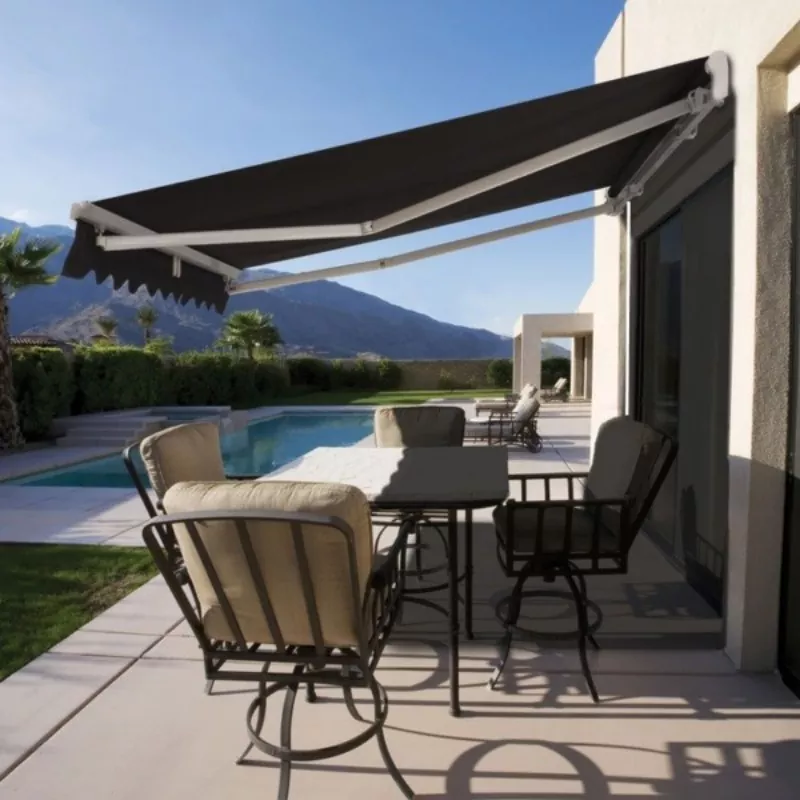
A retractable awning is an outdoor shading system designed to extend when shade is needed and retract when an open outdoor environment is preferred. Unlike a fixed canopy, it allows users to control how much of the outdoor area is covered.
A typical retractable awning consists of several major components:
- A durable fabric cover that provides shade and helps reduce direct solar exposure.
- A roller tube that stores the fabric when the awning is retracted.
- Folding support arms that maintain the fabric position when extended.
- Wall mounting brackets that connect the awning structure to the building.
- An operating mechanism that controls extension and retraction.
- Optional protective housing that helps shield the fabric when it is not being used.
The fundamental structure of a manual and motorized awning can be very similar. The main difference is the operating mechanism. Manual systems use mechanical force from the user, while motorized systems use an electric motor to rotate the roller tube.
This distinction is important because the operating method affects everyday convenience, installation requirements, maintenance, and the features that can be added to the system.
For example, a homeowner who opens the awning once every few days may not gain much practical value from an electric motor. In contrast, a restaurant that adjusts its outdoor shade several times throughout the day can benefit considerably from push button operation.
Why Choose a Manual Retractable Awning
A manual retractable awning remains a practical choice for many residential and commercial applications. Its biggest advantage is simplicity. Instead of relying on electricity, sensors, or electronic controls, the user operates the system directly through a crank mechanism.
Manual operation can be particularly suitable when the awning is relatively easy to reach and does not need to be adjusted frequently.
What Are the Main Advantages of Manual Operation
- Lower initial complexity: A manual system does not require an electric motor or electrical control system.
- No dedicated power connection: Installation can be easier when there is no convenient electrical supply near the mounting position.
- Simple operation: The mechanical crank provides direct control over the awning.
- Easy maintenance: There are fewer electrical components that require inspection or replacement.
- Good value for occasional use: If the awning is only opened periodically, paying extra for automation may not provide enough additional value.
- Suitable for smaller installations: Smaller patios, balconies, windows, and compact outdoor seating areas can work well with manual operation.
When Does a Manual Retractable Awning Make More Sense
Consider a manual system when the following conditions apply:
- The awning is relatively small or moderate in size.
- The operating position is easy to reach.
- The awning will only be adjusted occasionally.
- There is no convenient electrical connection.
- The project has a strict budget.
- You prefer a straightforward mechanical system.
For example, a small residential balcony that requires shade mainly during the afternoon may not need automated operation. The owner can extend the awning when needed and retract it when the outdoor area is no longer being used.
For many projects, this simplicity is an advantage rather than a limitation.
How Does a Motorized Retractable Awning Work
A motorized retractable awning replaces the traditional hand crank with an electric motor. When the user activates the control system, the motor rotates the roller tube, allowing the fabric to extend or retract while the support arms move into the required position.
Depending on the system configuration, the awning may be controlled using a remote control, wall switch, smart control system, or other compatible operating device.
What Makes Motorized Operation Different
The biggest difference is not simply that the awning moves automatically. Motorization also makes additional functions possible.
- Remote controlled opening and closing.
- Wall mounted control.
- Optional smart control integration.
- Wind sensor integration.
- Sun sensor integration on compatible systems.
- Automatic retraction under selected weather conditions.
- Consistent positioning each time the awning is operated.
These functions can make a significant difference when the awning is used frequently. Instead of walking to the crank and manually operating the system, the user can adjust the shade from a convenient position.
At Vionta Metal, we consider motorization particularly useful when an outdoor shade system is expected to become part of the daily routine rather than something used occasionally.
Why Are Weather Sensors Important
Wind is one of the most important considerations for retractable awnings. Extended fabric creates a large surface area that can be affected by wind loads. A retractable awning should therefore be retracted when weather conditions exceed the operating limits specified for the particular system.
A compatible wind sensor can provide an additional layer of convenience by detecting changing conditions and triggering automatic retraction. However, sensors should not be treated as a replacement for proper product selection, structural installation, or following the manufacturer's weather operating instructions.
What Is the Difference Between Motorized and Manual Retractable Awnings
The best way to compare the two systems is to look at the factors that affect everyday ownership rather than focusing only on the purchase price.
| Factor | Manual Retractable Awning | Motorized Retractable Awning |
| Operation | Hand crank or mechanical mechanism | Electric motor with switch, remote, or compatible control |
| Power requirement | No electrical power required | Electrical power is normally required |
| Convenience | Good for occasional adjustment | Excellent for frequent adjustment |
| Automation | Limited | Can support sensors and smart controls depending on configuration |
| Installation | Generally simpler from an electrical perspective | Requires consideration of motor and power installation |
| Maintenance | Primarily mechanical inspection and fabric care | Mechanical inspection plus motor and control components |
| Typical application | Smaller spaces and occasional use | Larger spaces and frequent daily use |
| Accessibility | Requires physical operation | Easier for users who prefer push button operation |
The comparison shows that neither system is automatically better. The right choice depends on how the awning will actually be used.
A common mistake is choosing a motorized system simply because it has more features. If the awning is small, easy to operate, and rarely adjusted, those additional features may have limited practical value.
The opposite mistake is choosing a manual system for a large outdoor terrace that needs to be adjusted several times a day. In that situation, the lower initial cost may be offset by reduced convenience over many years of use.
Why Choose a Motorized Retractable Awning
Motorization becomes increasingly valuable as the size, frequency of use, or functional requirements of the project increase.
What Are the Biggest Benefits of Motorization
- One touch operation: The awning can be extended or retracted without manually turning a crank.
- Better everyday convenience: Frequent shade adjustments become much easier.
- Improved accessibility: Users who find manual cranking difficult can operate the awning with a control device.
- Weather automation: Compatible wind sensors can automatically retract the awning when conditions become unsuitable.
- Consistent operation: The motor provides repeatable movement without relying on different amounts of manual force.
- Smart control potential: Some systems can be integrated into broader home or commercial automation systems.
Why Is Motorization Especially Useful for Large Awnings
The larger the awning, the more important operating convenience becomes. A wide awning may cover a substantial outdoor seating or living area. If users need to extend and retract it repeatedly, manual operation can become inconvenient over time.
This is particularly relevant for restaurants, hotels, villas, large patios, outdoor lounges, and commercial terraces.
For these applications, the awning is often part of a broader outdoor living or hospitality system. Users may need to react quickly to changing sunlight, temperature, customer requirements, or weather conditions. Motorized operation makes those adjustments easier.
At Vionta Metal, we look at the complete application before determining whether motorization is appropriate. Size, mounting position, frequency of use, local climate, control requirements, and customer expectations should all be considered together.
How Do You Choose the Right Retractable Awning for Your Project
Instead of asking only whether motorized or manual operation is better, ask a series of practical questions about the project.
How Often Will You Open and Close the Awning
This is one of the most important questions.
If the awning is opened once in the morning and closed once in the evening, manual operation may be perfectly adequate. If the awning is adjusted several times throughout the day, motorization becomes much more attractive.
How Large Is the Awning
Size affects both structural requirements and operating convenience. A larger projection and wider span can make manual operation less appealing, particularly when the awning is used frequently.
Before ordering, measure both the available mounting width and the required projection. Also consider doors, windows, roof lines, balconies, lighting fixtures, drainage paths, and other architectural elements around the installation area.
Where Will the Awning Be Installed
A first floor patio and a high terrace may have completely different operating requirements.
If the operating mechanism is difficult to reach, motorization can eliminate an unnecessary access problem. For high mounting positions or commercial installations, remote operation can be especially useful.
What Is Your Local Weather Like
Climate should influence both the awning structure and operating method.
- High wind areas require careful attention to structural design and operating limits.
- Strong sunlight increases the importance of fabric quality and UV resistance.
- Frequent rain requires consideration of fabric characteristics, pitch, drainage, and operating instructions.
- Seasonal weather may determine how frequently the awning is extended.
A motorized system with compatible weather sensing can be particularly useful where sudden changes in weather are common. However, no retractable awning should be left extended beyond its specified weather limits.
Do You Need Smart or Automatic Control
If you want the awning to work with a smart outdoor living system, motorization is usually the logical starting point.
Depending on the selected motor and control system, additional functions may include remote control, timers, sensors, or integration with other building systems.
What Is Your Project Budget
Manual operation generally has a lower system cost because it does not require a motor and associated electrical control components.
Motorization adds equipment and installation requirements, but the additional investment can be justified when convenience, accessibility, automation, and frequent operation are important.
The correct approach is to compare total project value rather than simply choosing the lowest purchase price.
What Other Factors Should You Consider Before Buying
Operation type is only one part of the buying decision. A high quality retractable awning should be evaluated as a complete system.
What Fabric Should You Choose
The fabric affects appearance, shade performance, durability, maintenance requirements, and resistance to outdoor exposure.
For long term outdoor applications, consider:
- UV resistance.
- Color retention.
- Water resistance or water repellency where required.
- Fabric weight and construction.
- Cleaning requirements.
- Suitability for the local climate.
The fabric should also be compatible with the intended awning structure and operating method.
How Important Is the Frame Construction
The frame and support arms carry the operational loads of the system. Aluminum is commonly used because it offers a useful combination of low weight, corrosion resistance, and structural performance when properly designed and finished.
For outdoor installations, coating quality is also important. A durable powder coated finish can help protect metal components against normal outdoor exposure while providing the desired appearance.
What Type of Housing Should You Consider
Awnings can be supplied with different levels of protection for the rolled fabric and mechanical components.
An open design leaves more components exposed when retracted. A semi protective housing can shield part of the system, while a full cassette can enclose the rolled fabric and other components more completely.
For projects where appearance and fabric protection are important, a cassette design may provide a cleaner architectural appearance when the awning is closed.
How Should You Think About Installation
Correct installation is just as important as selecting the right awning.
The installer should evaluate the wall structure, mounting surface, bracket positions, fixing method, projection, operating clearance, and local environmental conditions.
Motorized installations also require proper planning for electrical connections and control equipment. The wiring and power requirements should be considered before installation begins rather than after the awning has already been manufactured.
At our factory, we can evaluate product configuration requirements with buyers before production so that dimensions, operating methods, finish, fabric selection, and optional functions are aligned with the project.
What Are the Most Common Buying Mistakes
Several mistakes appear repeatedly when customers select outdoor shading systems.
Choosing Only Based on Price
The cheapest awning is not necessarily the most economical choice. Fabric quality, frame construction, mounting hardware, operating mechanism, finish, motor quality, and after sales support can all influence long term value.
Ignoring Wind Conditions
Retractable awnings are designed to be retracted when weather conditions become unsuitable. Buyers should understand the operating limits of the selected system and make sure users know when the awning should be closed.
Underestimating How Often the Awning Will Be Used
A manual system may look attractive during the initial purchase decision. However, if users need to operate it several times every day, convenience becomes an important part of the product value.
Forgetting the Installation Surface
The wall must be capable of supporting the mounting system. Brick, concrete, steel, timber, insulated walls, and other substrates may require different fixing solutions.
Buying the Motor as an Afterthought
If motorization may be required in the future, it is better to discuss this before production. The awning structure, motor position, electrical routing, control method, and available space should be considered as part of the original design.
Which Retractable Awning Should You Get
So, motorized or manual retractable awning, which should you get?
Choose a manual retractable awning if you want a straightforward mechanical solution, your awning is relatively easy to reach, you use it occasionally, and keeping the initial investment lower is important.
Choose a motorized retractable awning if you have a larger installation, use the awning frequently, need convenient remote operation, have accessibility considerations, or want functions such as compatible wind sensors and smart controls.
| If your priority is | Recommended option |
| Lower initial investment | Manual |
| Simple mechanical operation | Manual |
| Occasional use | Manual |
| Frequent daily operation | Motorized |
| Large outdoor areas | Motorized |
| Remote operation | Motorized |
| Weather sensor integration | Motorized |
| Smart control requirements | Motorized |
There is no universal winner. The right retractable awning is determined by the relationship between size, frequency of use, installation conditions, weather exposure, budget, and desired convenience.
Vionta Metal provides retractable awning solutions for residential, commercial, hospitality, and architectural applications. Our team can work with project buyers to evaluate dimensions, materials, finishes, operation methods, motorization requirements, and customized configurations.
If you are sourcing retractable awnings for a new project, renovation, wholesale program, or architectural application, contact Vionta Metal with your required width, projection, installation environment, preferred operation, fabric requirements, and estimated quantity. We can help you determine whether a manual or motorized configuration is more appropriate and develop a practical solution for your project.
Retractable Awning FAQ
What Is the Main Difference Between a Motorized and Manual Retractable Awning
A motorized retractable awning uses an electric motor to extend and retract the fabric, while a manual retractable awning uses a hand crank or mechanical operating mechanism. Motorized systems provide greater convenience and can support additional functions such as remote controls and compatible weather sensors. Manual systems are mechanically simpler, do not require electrical power, and can be a practical choice for smaller awnings or occasional use.
Why Should I Choose a Motorized Retractable Awning Instead of a Manual One
A motorized retractable awning is generally the better choice when the system will be operated frequently, covers a large outdoor area, is installed in a difficult to reach location, or requires automated control. Push button operation makes it easier to adjust shade throughout the day, while compatible sensors can provide automatic retraction under selected weather conditions. The additional cost is most worthwhile when convenience and frequent operation are important parts of the project.
How Long Does a Retractable Awning Last
The service life of a retractable awning depends on fabric quality, frame construction, installation quality, frequency of use, climate, maintenance, and how the system is operated during adverse weather. The fabric is normally more exposed to aging than the metal frame because it receives direct sunlight, moisture, and environmental contamination. Regular cleaning, correct operation, proper retraction during unsuitable weather, and suitable storage or cassette protection can help extend the useful life of the system.
What Size Retractable Awning Should I Buy
The correct size depends on the available mounting width, required projection, desired shaded area, building structure, and local installation conditions. Start by measuring the wall or mounting area and determine how far the shade needs to extend from the building. Also check doors, windows, roof edges, lighting, drainage, balconies, and other obstacles. For larger or customized installations, the structure and mounting method should be evaluated before final dimensions are confirmed.
Are Motorized Retractable Awnings Worth the Extra Cost
A motorized retractable awning can be worth the additional investment when convenience, frequent operation, accessibility, large dimensions, or automated weather control are important. If the awning will only be opened occasionally and is easy to operate manually, the additional cost of motorization may not provide enough practical benefit. The best way to evaluate the investment is to consider how often the system will be used and which functions are genuinely important for the project rather than choosing based only on the presence of more features.
Ready to transform your outdoor space? Contact Vionta Metal today for a personalized recommendation and free on-site assessment. We deliver excellence in every retractable awning we craft.
Related News
- Why Stainless Cable Railing Shines in Winter?
- How Can a Snow Load Aluminum Pergola Deliver Reliable Year-Round Outdoor Protection
- What Awning Fabric and Frame Options Are Available?
- Is Glass Railing Safe for Balconies and Terraces?
- What Makes Stainless Steel the Ideal Material for Outdoor Railings?
- Are Jalousie Windows Easy to Break Into?
Leave me a message