How to Improve the Wind Resistance of Aluminum Pergolas?
When investing in an outdoor living space, few elements offer the elegance and durability of a well-designed aluminum pergola. However, for homeowners and business owners in regions prone to gusty conditions, the critical question is not just about aesthetics—it is about structural integrity. Over the past two decades in the structural metals industry, we have observed a significant shift in consumer priorities: beauty must now coexist with brute resilience against nature's forces. This comprehensive guide delves deep into engineering principles, material science, and practical installation tactics to ensure your aluminum pergola remains steadfast even when the wind howls. We at Vionta Metal have dedicated our factory’s R&D to solving these exact challenges, and we are here to share our hard-won expertise.
Table of Contents
- Why Does Wind Resistance Matter for Modern Pergolas?
- What Engineering Principles Govern a Pergola’s Stability?
- How Can You Select the Optimal Aluminum Grade for High-Wind Zones?
- Which Foundation and Anchoring Systems Provide Maximum Hold?
- What Role Do Louvers and Roofing Profiles Play in Wind Mitigation?
- How Does Proper Installation Differ from Standard Assembly in Windy Areas?
- Why Should You Consider Retrofitting Existing Structures for Better Aerodynamics?
- How Can Maintenance Routines Preserve Wind Resistance Over Time?
Why Does Wind Resistance Matter for Modern Pergolas?
Wind resistance is not merely a technical specification—it is a safety imperative. An aluminum pergola that fails under wind stress can cause property damage, personal injury, and significant financial loss. Unlike wood or steel, aluminum offers a unique balance of lightness and strength, but this lightness can be a double-edged sword. Without proper design and anchoring, even a well-crafted aluminum structure can become a projectile in severe weather.
Furthermore, insurance companies and local building codes are increasingly demanding certified wind-load calculations for outdoor structures. A pergola that meets or exceeds local wind speed requirements not only protects your investment but also enhances property value. In our factory at Vionta Metal, we routinely test our components against simulated Category 3 hurricane winds to ensure every extrusion and fastener performs under pressure. We also recognize that wind resistance directly influences the longevity of the finish; high winds often carry abrasive dust and salt, which can degrade coatings if the structure vibrates excessively. Therefore, improving wind resistance is synonymous with preserving the aesthetic appeal of your outdoor oasis.
Why should you prioritize this over other features? The answer is simple: safety and peace of mind. A pergola that sways or creaks in a breeze is a pergola that will not last. By addressing wind resistance upfront, you avoid costly repairs, legal liabilities, and the emotional toll of watching your dream project collapse. For commercial applications, such as restaurants or resort cabanas, wind-resistant pergolas ensure uninterrupted business operations, protecting patrons and staff alike. Ultimately, the question is not whether you can afford to improve wind resistance, but whether you can afford not to.
What Engineering Principles Govern a Pergola’s Stability?
To fortify an aluminum pergola, you must first understand the physics at play. Wind imposes both lateral (horizontal) and uplift (vertical) forces on a structure. Lateral forces push against the posts and beams, while uplift forces attempt to rip the roof off the columns. The stability of your pergola hinges on three core principles: moment resistance, load path continuity, and damping.
- Moment Resistance: This is the ability of a joint to resist bending. In high-wind scenarios, the corners of the pergola experience the greatest moment forces. Using heavy-duty corner brackets, gusset plates, or welded connections rather than simple screw fasteners dramatically increases moment resistance. At Vionta Metal, we engineer our connectors with reinforced ribs that distribute stress over a larger surface area, reducing the risk of shear failure.
- Load Path Continuity: A stable pergola ensures that wind forces are transmitted sequentially from the roof, through the columns, down to the foundation, and finally into the ground. Any break in this load path—such as a weak post-base connector or a shallow footing—creates a structural weak link. We always advise our clients to envision the force flow and verify that each connection is rated for the cumulative load.
- Damping and Vibration: Wind-induced oscillations can cause fatigue over time, loosening fasteners and cracking welds. Incorporating rubber isolators or neoprene pads between the columns and the base plate can absorb micro-vibrations. Additionally, adding diagonal cross-bracing (either cable or solid strut) transforms a rectangular frame into a triangulated system, which is inherently more rigid. How does triangulation work? It converts horizontal shear into axial compression and tension, forces that aluminum handles exceptionally well.
- Center of Gravity: A lower center of gravity generally improves stability. This is why we recommend heavier gauge posts at the perimeter and lighter infill elements for the canopy. By concentrating mass at the base, the pergola resists overturning moments more effectively. Our factory often customizes base plates that are 30% thicker than industry standards for coastal projects.
Understanding these principles allows you to ask the right questions when purchasing or designing your structure. Do the product specifications include wind load charts? Have the components been tested in an accredited wind tunnel? These are not marketing gimmicks; they are engineering necessities.
How Can You Select the Optimal Aluminum Grade for High-Wind Zones?
Not all aluminum is created equal. The most common alloys for pergolas are 6061 and 6063, but their mechanical properties differ significantly. 6061-T6 offers a higher yield strength (approximately 40,000 psi) compared to 6063-T5 (around 25,000 psi). For wind-prone areas, 6061 is the superior choice because it resists bending and twisting under lateral loads. However, 6063 is more extrudable and offers better surface finish, which is why many manufacturers prefer it. We recommend a hybrid approach: use 6063 for decorative trim and 6061 for the primary load-bearing columns and rafters.
Beyond the alloy, the temper designation is crucial. T6 temper involves solution heat treatment and artificial aging, resulting in maximum hardness. When you examine an extrusion, ask for the mill test certificates. These documents verify that the material meets ASTM B221 standards. Additionally, consider the wall thickness. While a 2.0mm wall might suffice for a sheltered garden, coastal or open-plain installations demand at least 2.5mm to 3.0mm for the main posts. We have seen many imported pergolas fail because they used thin-walled extrusions to cut costs. In our factory, we never compromise on gauge; we believe that structural integrity is the foundation of our reputation.
Another overlooked factor is the corrosion resistance in saline environments. While aluminum naturally forms an oxide layer, high winds drive salt spray into crevices, accelerating galvanic corrosion. Opt for alloys with higher magnesium content (like 5083) for coastal applications, though these are more expensive. A more practical approach is to specify a premium anodic coating or powder coating with a UV-stable primer. This not only protects against corrosion but also reduces surface friction, allowing wind to slide over the profiles rather than grab them. What is the key takeaway? Always prioritize strength and corrosion resistance over initial cost savings. The long-term maintenance savings will more than justify the upfront investment.
Which Foundation and Anchoring Systems Provide Maximum Hold?
The most robust aluminum pergola is only as good as its connection to the ground. In high-wind zones, traditional surface-mounting with expansion bolts is often insufficient. We advocate for embedded post anchors or concrete footings with a minimum depth below the frost line. For regions with wind speeds exceeding 120 mph, consider helical piles or screw anchors that penetrate deep into stable soil strata. These systems provide uplift resistance that far exceeds standard footings.
- Concrete Footings with Rebar: A 24-inch diameter footing poured at least 36 inches deep, reinforced with steel rebar, creates a massive inertia block. The pergola posts should be anchored via J-bolts cast into the wet concrete. This method transfers both compression and tension directly into the mass of concrete.
- Base Plate Design: The interface between the post and the footing is critical. We recommend base plates with multiple bolt holes (at least four per corner) and a thickness of 10mm or more. A slotted base plate allows for minor adjustments during installation, ensuring the columns are perfectly plumb. However, after alignment, we suggest welding the base plate to the post for a permanent, rigid connection.
- Chemical Anchors: For retrofitting existing patios, chemical anchors (epoxy-based) offer superior holding power compared to mechanical expansion bolts. They bond to the concrete at a molecular level, providing consistent performance even under cyclic loading. At Vionta Metal, we often supply pre-drilled post bases with chemical anchor kits for our DIY customers.
- Deadman Anchors: For freestanding pergolas with no structural connection to a house, deadman anchors—buried concrete blocks connected to the posts via steel cables—can be a lifesaver. These are particularly effective against uplift because the mass of the buried block resists vertical movement.
How do you choose the right system? The answer depends on your soil type (clay, sandy, or rocky), local wind speed maps, and the height of your pergola. Taller structures (over 10 feet) require proportionally larger footings because the leverage effect magnifies the wind force at the base. We always recommend consulting a structural engineer for custom projects. In our experience, investing in a premium anchoring system is the single most cost-effective way to improve wind resistance.
What Role Do Louvers and Roofing Profiles Play in Wind Mitigation?
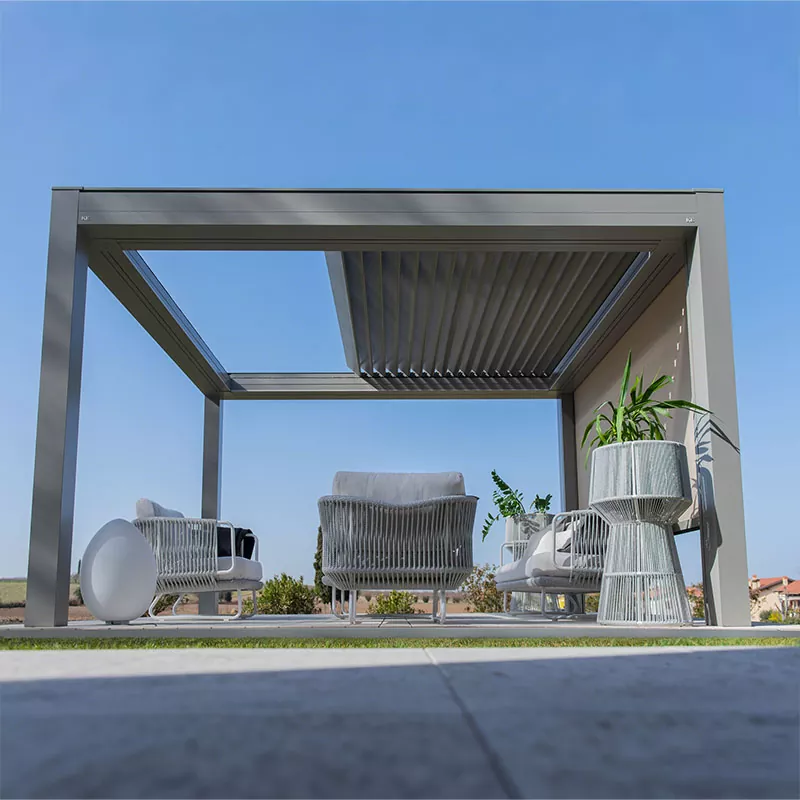
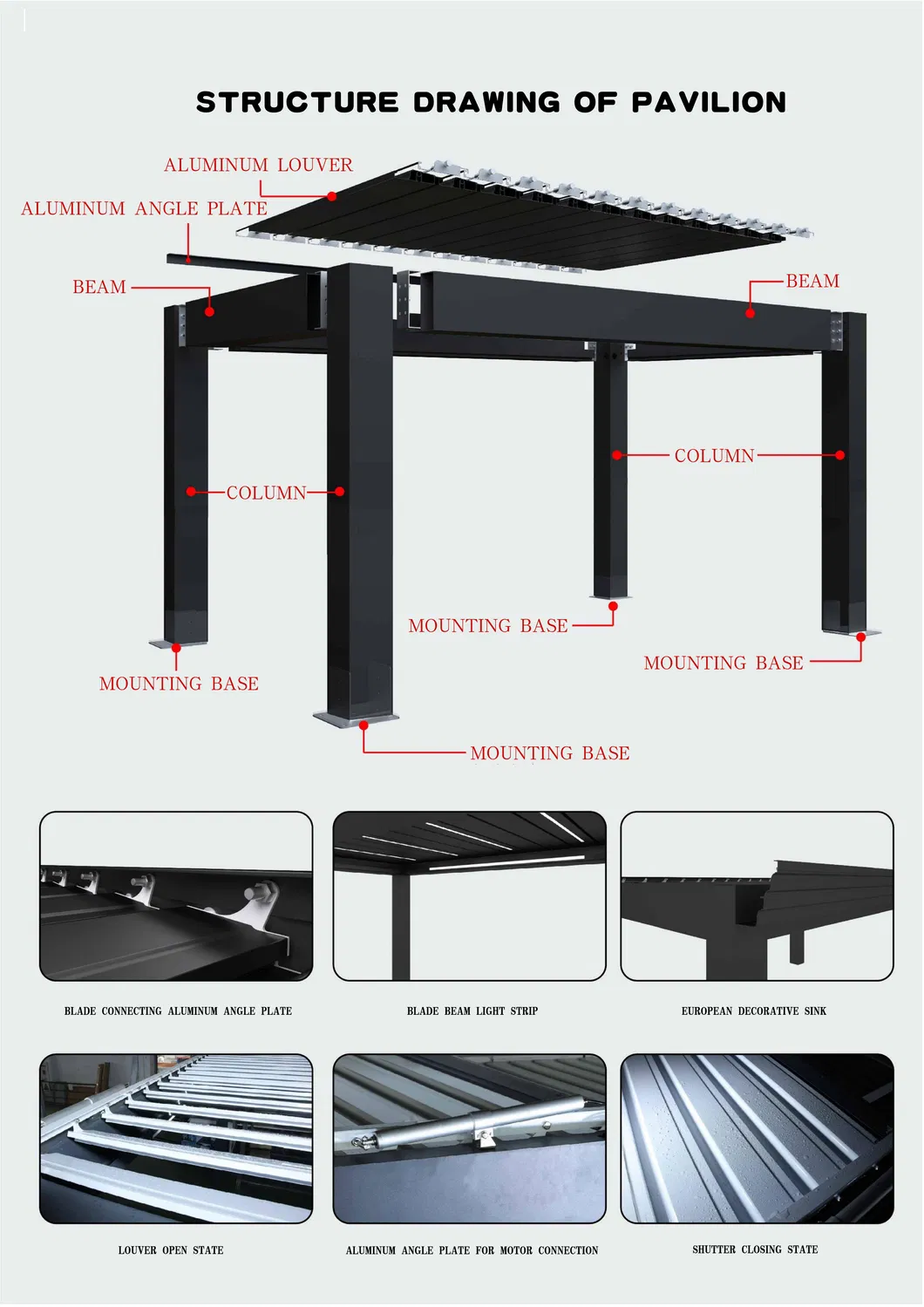
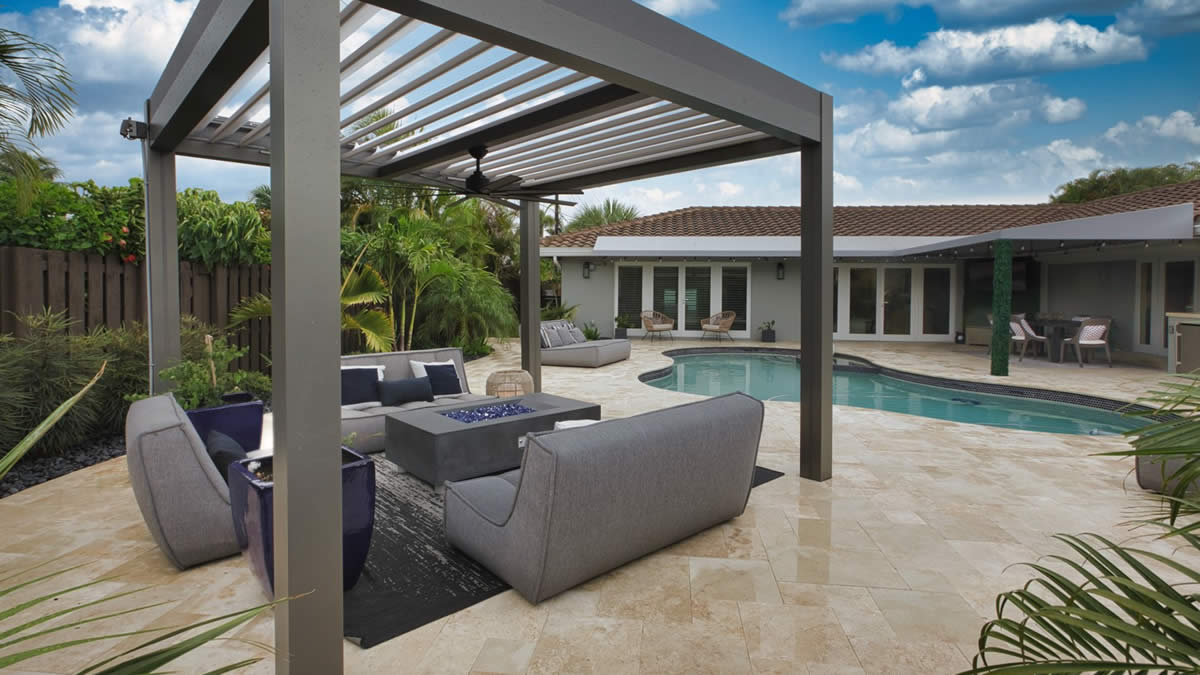
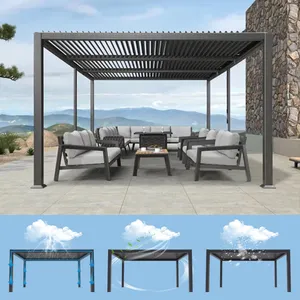
The roof of an aluminum pergola is the primary surface that catches wind. Solid roofs, while offering full shade, act like sails and generate immense uplift forces. Conversely, open-grid roofs allow wind to pass through but offer little rain protection. The modern solution is the adjustable louver system. When closed, the louvers form a watertight barrier, but when tilted at a 30- to 45-degree angle, they allow wind to flow through while still blocking direct sunlight. This venting effect reduces the net wind load on the structure by up to 40%.
However, not all louver profiles are aerodynamically efficient. Sharp edges create turbulence, increasing drag and noise. We design our louvers with rounded leading edges and teardrop cross-sections—a shape borrowed from aviation engineering. These profiles guide airflow smoothly over the surface, reducing the coefficient of drag. Additionally, the spacing between louvers is critical. If the gaps are too narrow, wind accelerates through them, creating a Venturi effect that can actually increase pressure differentials. Our factory’s computational fluid dynamics simulations have shown that a 1.5-inch gap between louvers provides optimal pressure relief while maintaining adequate shade coverage.
For fixed-roof pergolas, consider using perforated panels or polycarbonate sheets with a wave profile. The waves act as turbulators, breaking up the wind’s laminar flow and preventing the formation of large pressure gradients. Another innovative approach is the use of wind-deflecting fins mounted on the roof’s leading edge. These fins angle upward, channeling the wind over the top of the structure rather than against it. We have implemented this design for several commercial projects, and the feedback has been overwhelmingly positive—not only for wind performance but also for acoustic comfort, as the fins reduce wind roar.
How Does Proper Installation Differ from Standard Assembly in Windy Areas?
Installation is where most wind-resistance failures occur. Even a perfectly engineered pergola can underperform if it is assembled incorrectly. In standard conditions, a level square frame and hand-tightened fasteners might suffice. In windy areas, every step demands precision and over-engineering. First, torque wrenches must be used for all bolted connections. The manufacturer’s specified torque values are not suggestions—they are calculated to create proper clamp force without stripping threads. We recommend using anti-seize compound on stainless steel bolts to prevent galling, which ensures you can achieve the required torque.
Second, diagonal bracing must be installed during the initial frame assembly, not added later as an afterthought. The braces should be secured with tensioners so that they are pre-stressed, removing any slack that could allow micro-movements. For pergolas attached to a house wall, the ledger board must be bolted into the home’s structural framing—not just the siding or veneer. We have seen numerous cases where the ledger pulled away from the house because lag bolts were driven only into brick veneer. Always use structural screws with a minimum embedment of 3 inches into the wall studs or floor joists.
Third, consider the direction of prevailing winds. Orienting the pergola so that the long axis is parallel to the dominant wind direction reduces the frontal area exposed to gusts. If the layout is fixed, install wind baffles or screens on the upwind side to deflect the initial blast. Our field team at Vionta Metal consistently uses laser levels to ensure columns are perfectly vertical; even a 1-degree tilt multiplies the bending moment exponentially under wind load. Finally, perform a post-installation inspection after the first major storm. Re-torque all connections, check for hairline cracks in welds, and verify that the anchor bolts have not loosened. Proactive maintenance is far less expensive than reactive repair.
Why Should You Consider Retrofitting Existing Structures for Better Aerodynamics?
Many homeowners have existing aluminum pergolas that were installed without considering high-wind events. Retrofitting is a practical and economical solution to upgrade their performance. The first step is to assess the current condition—check for rust at the base, loosened fasteners, and any signs of fatigue in the framing. Once the assessment is complete, you can implement several retrofits: add cross-cables with turnbuckles to introduce triangulation; replace standard louver motors with models that have wind sensors that automatically close or tilt the louvers to a safe angle during storms; and install heavier-duty post bases that are bolted through the existing concrete.
Another powerful retrofit is the addition of external shear panels. These are thin aluminum sheets that are bolted diagonally across the bays of the pergola. They significantly increase the structure’s racking resistance without adding much weight. We have also had success with adding wind stays—rigid struts that connect the roof beam to the post mid-height, effectively reducing the unsupported length of the column. How does this help? By shortening the column, you reduce its slenderness ratio, making it less prone to buckling.
For commercial clients, we often recommend installing a wind-monitoring system that provides real-time data on gusts and structural movement. This data can be used to activate automatic louver adjustments or even send alerts to facility managers. Our factory has developed a proprietary retrofit kit that includes all the hardware and a step-by-step guide, enabling most contractors to complete the upgrade within a weekend. Retrofitting not only extends the lifespan of your pergola but also increases your property’s resilience, which is increasingly valuable in the eyes of insurers and potential buyers.
How Can Maintenance Routines Preserve Wind Resistance Over Time?
Wind resistance is not a static property; it degrades as components wear. Regular maintenance is the key to sustaining peak performance. We recommend a quarterly inspection cycle, particularly after severe weather events. During these inspections, check for: corrosion around fasteners, which can reduce clamp force; deformation of the louver blades, which can alter their aerodynamic profile; and settling of the footings, which can cause columns to lean. Use a simple level to verify plumbness and a torque wrench to spot-check critical bolts.
Lubrication is equally important. The moving parts of louver systems should be cleaned and lubricated with a silicone-based spray every six months. This prevents seizing and ensures that the louvers can rotate freely to their wind-relief position. Also, examine the powder coating for chips or scratches; any bare aluminum exposed to the elements is vulnerable to pitting corrosion, which weakens the material over time. Touch up these areas with a matching corrosion-inhibiting paint.
Keep the gutters and downspouts clear. Blocked drainage can lead to water pooling on the roof, adding dead weight that strains the structural connections. In regions with freeze-thaw cycles, standing water can freeze and expand, cracking the louver mechanisms. We also advise trimming any overhanging tree branches that could fall during a storm and damage the pergola. A simple yet often overlooked task is to tighten the set screws on the louver drive shafts; these can back out due to vibration, causing misalignment. By adhering to these maintenance routines, you ensure that your pergola remains as robust on year ten as it was on day one. At Vionta Metal, we provide a detailed maintenance logbook with every order, helping our clients track their inspections and repairs systematically.
Conclusion: Building Resilience for the Long Haul
Improving the wind resistance of an aluminum pergola is a multifaceted endeavor that combines smart material selection, rigorous engineering, meticulous installation, and ongoing care. From understanding the fundamental physics of wind loads to retrofitting older structures with modern innovations, each step contributes to a safer, more durable outdoor space. We at Vionta Metal have spent decades refining our production processes to ensure that every extrusion, connector, and louver that leaves our factory meets the highest standards of wind performance. We believe that a pergola is not just a shade structure; it is a sanctuary that should withstand the test of time and weather.
As you plan your next pergola project, we invite you to consider the full lifecycle costs and benefits. Our team is dedicated to providing not only high-quality products but also the technical guidance to install and maintain them correctly. Whether you are a homeowner seeking peace of mind or a contractor looking for reliable components, we are your partner in building resilience. Remember, the best time to improve wind resistance is before the first gust, not after the damage is done. We encourage you to contact our technical sales team to discuss your specific needs—we are always ready to share our expertise and help you design a pergola that stands strong, no matter what nature throws its way.
Take action today: download our wind-load specification guide, request a consultation, or visit our showroom to see our wind-tested assemblies in person. Your dream outdoor space deserves the strongest foundation, and we are here to deliver it. Let us build something that lasts—together.
Frequently Asked Questions (FAQ) About Aluminum Pergola Wind Resistance
What wind speed can a standard aluminum pergola withstand without additional reinforcement?
A standard aluminum pergola, typically built with 6063-T5 extrusions and 2.0mm wall thickness, is generally rated for wind speeds up to 90 mph (145 km/h) when properly anchored. However, this rating assumes perfect installation, rigid soil conditions, and a closed-louver or solid roof configuration. In our experience, this baseline is often optimistic, as field conditions vary. For example, if the pergola is installed on loose soil or with substandard footings, the effective resistance may drop to 70 mph. To safely withstand Category 1 hurricane winds (95 mph+), we strongly recommend upgrading to 6061-T6 alloy, increasing post thickness to 3.0mm, and using helical pile foundations. Our factory at Vionta Metal produces a "Hurricane Series" that is independently tested to 130 mph, but we always advise clients to check local building codes, as requirements differ by region. Ultimately, the safest approach is to request wind load calculations from the manufacturer that are specific to your site’s exposure category (open terrain, suburban, or urban).
How does the color or finish of an aluminum pergola affect its wind resistance?
While the color itself does not change the structural strength, the finish type can indirectly influence wind performance. A high-gloss, smooth powder coating reduces surface roughness, allowing wind to flow more laminarly over the profiles, which slightly lowers the drag coefficient. Conversely, textured or matte finishes create micro-turbulence that can increase drag—though the effect is minimal for most residential applications (usually less than 5% difference). The more critical factor is the finish’s durability. In coastal areas, a premium fluoropolymer coating (like PVDF) resists salt-induced corrosion far better than standard polyester powders. Corrosion can weaken the aluminum substrate over time, leading to pitting and reduced wall thickness, which directly compromises wind resistance. Therefore, we recommend investing in a high-quality, UV-stable coating with a minimum thickness of 80 microns. At Vionta Metal, we offer a 10-year warranty on our architectural coatings, and we emphasize that a well-maintained finish is a silent contributor to long-term structural integrity. So, while color is primarily aesthetic, the finish’s quality is a functional decision.
Can I install an aluminum pergola on an existing wooden deck without compromising wind resistance?
Yes, but with significant caveats. Wooden decks are notoriously flexible and may not provide the rigid base required for high-wind resistance. If you must install on a deck, the deck’s framing must be beefed up substantially. We recommend adding additional joists beneath the pergola posts and installing blocking between joists to distribute the point loads. The post bases should be bolted through the decking and into the structural framing using through-bolts with large backing plates (at least 4x4 inches) rather than lag screws. Moreover, the deck itself must be adequately anchored to the house foundation; many decks are only attached with nails or simple brackets, which will fail under uplift. Consider installing independent concrete piers through the deck—cutting holes in the deck surface and pouring footings below—to create a separate load path. This is the safest method. In our factory, we often collaborate with deck builders to design hybrid systems. Always consult a structural engineer to evaluate the deck’s capacity, especially if your pergola exceeds 8 feet in height. Remember, a pergola is only as strong as its foundation, and a floating deck is rarely a suitable foundation for windy locations.
Are adjustable louvers better for wind resistance than fixed slats or solid roofs?
Absolutely. Adjustable louvers offer a distinct aerodynamic advantage over both fixed slats and solid roofs. When a storm approaches, you can rotate the louvers to an open or angled position (typically 30-45 degrees), allowing the majority of wind to pass through the roof rather than exerting uplift pressure on the surface. This venting action can reduce the net wind load by 30-50%, depending on the louver profile and spacing. Fixed slats, while they allow some airflow, are static and cannot adapt to changing wind directions. Solid roofs, on the other hand, are the worst performers; they act as sails and transfer almost the entire wind force to the columns and anchors. Modern louver systems also feature automatic wind sensors that close or tilt the louvers when wind speeds exceed a preset threshold—typically 25-30 mph. This automation ensures the pergola is always in the safest configuration, even when you are not at home. We have integrated such sensors into our premium product lines, and the feedback from clients has been exceptional. Therefore, for any region that experiences occasional strong gusts, adjustable louvers are not just a convenience; they are a wind-resistance necessity.
How often should I inspect and re-torque the bolts on my aluminum pergola to maintain wind resistance?
We recommend a structured inspection schedule: initially, re-torque all critical bolts after the first 30 days of installation, as new structures settle and fasteners can relax. After that, perform a full inspection every six months, ideally before and after the storm season in your area. However, if you experience a major storm with winds exceeding 60 mph, you should inspect immediately afterward. During the inspection, check every anchor bolt, corner bracket, and louver pivot bolt. Use a torque wrench set to the manufacturer’s specified value—usually between 30-50 ft-lbs for M10 bolts, but always verify the documentation. Pay special attention to the base plate bolts, as these carry the brunt of uplift forces. We also suggest marking each bolt with a paint pen after torquing; this makes it easy to spot any movement at a glance. In our factory, we pre-torque components and ship them with a calibration certificate, but field conditions (temperature changes, vibrations) will always necessitate periodic checks. Also, examine the bolt threads for signs of rust or galling; if you encounter resistance when turning, clean the threads and apply a light lubricant. Proactive torque management is a small effort that yields significant safety dividends.
Ready to secure your outdoor space against the elements? Contact Vionta Metal today for a customized wind-resistant aluminum pergola solution. Our experts are standing by to assist you with technical specifications, installation guidance, and maintenance plans. Call us or fill out our online inquiry form to receive a free wind-load assessment—your peace of mind is just a click away. Protect your investment, enhance your lifestyle, and choose the strength of experience.
Related News
- Why Stainless Cable Railing Shines in Winter?
- How Can a Snow Load Aluminum Pergola Deliver Reliable Year-Round Outdoor Protection
- What Awning Fabric and Frame Options Are Available?
- Is Glass Railing Safe for Balconies and Terraces?
- What Makes Stainless Steel the Ideal Material for Outdoor Railings?
- Are Jalousie Windows Easy to Break Into?
Leave me a message