Main Parts of an Aluminum Louvered Pergola Explained
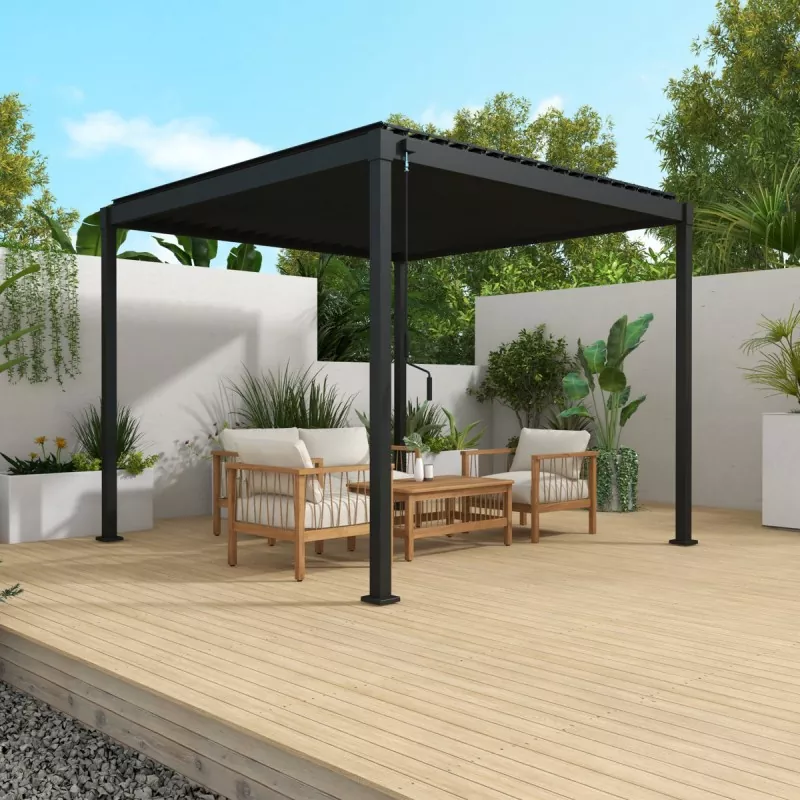
An Aluminum Louvered Pergola is not simply an outdoor shade structure. It is an engineered architectural system that combines structural strength, adjustable sun control, rain protection, and modern outdoor design. Behind the elegant appearance is a carefully designed combination of aluminum profiles, mechanical components, drainage systems, and connection parts that work together to create a comfortable outdoor environment.
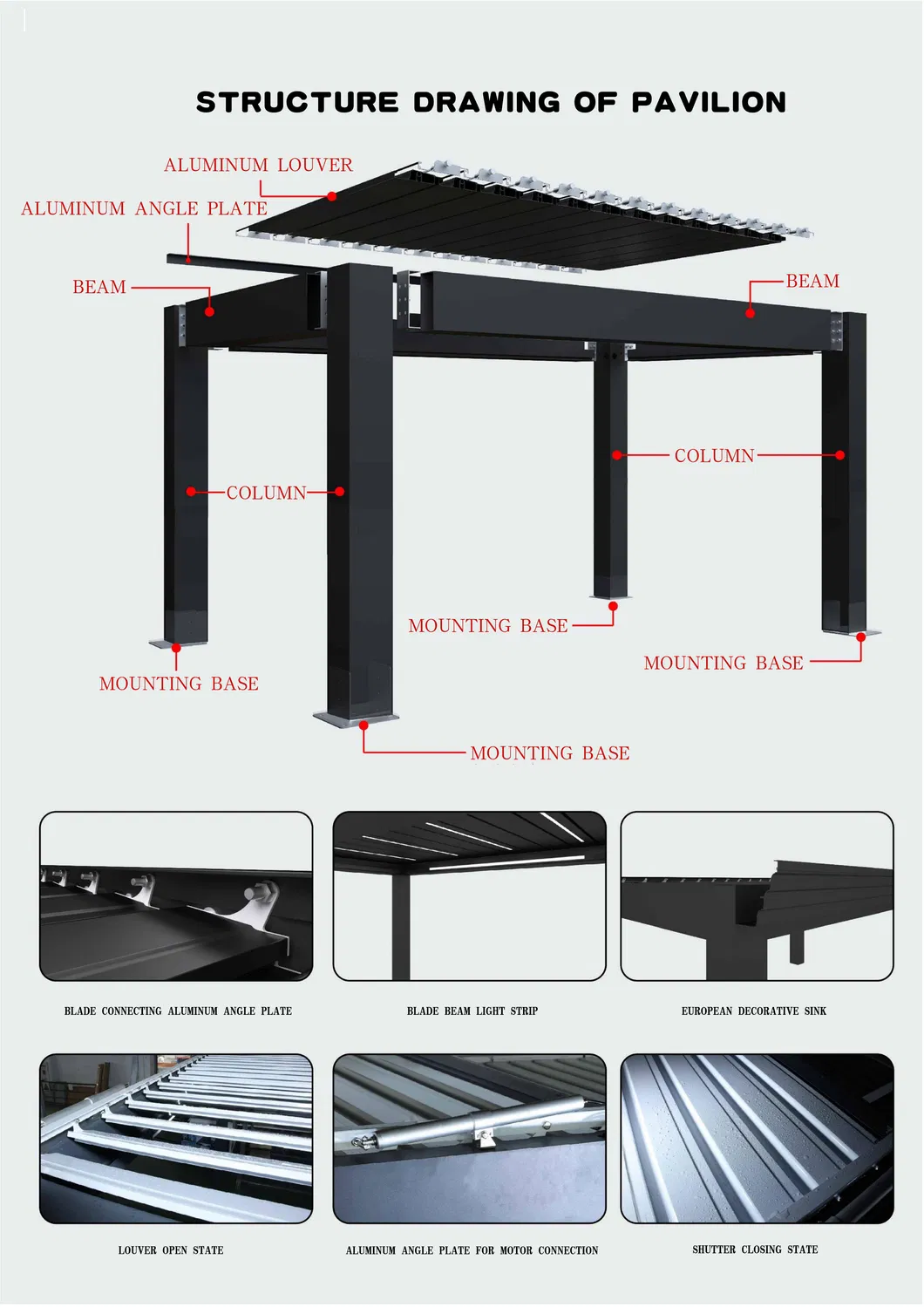
For architects, contractors, developers, and distributors, understanding the structure of an Aluminum Louvered Pergola is essential before selecting a supplier or preparing a project specification. Every component, from the aluminum louver on the roof to the mounting base fixed on the ground, directly influences durability, safety, appearance, and long term performance.
Based on the actual structure of modern aluminum pergola systems, this guide explains the key components shown in the structure drawing, including aluminum louvers, beams, columns, mounting bases, aluminum angle plates, motor connection systems, integrated lighting solutions, and decorative details.
At Vionta Metal, we focus on developing outdoor aluminum structures that combine functional engineering with contemporary architectural requirements. Our factory understands that a successful pergola project requires more than attractive design. It requires precise manufacturing, reliable components, and a complete system that performs well under different weather conditions.
Contents
- What Are the Main Parts of an Aluminum Louvered Pergola?
- Why Does Each Component Matter for Aluminum Louvered Pergola Performance?
- How Does an Aluminum Louvered Pergola Work as a Complete System?
- What Should Buyers Consider When Choosing an Aluminum Louvered Pergola Manufacturer?
- Frequently Asked Questions About Aluminum Louvered Pergola
What Are the Main Parts of an Aluminum Louvered Pergola?
The performance of an Aluminum Louvered Pergola depends on how every individual component works together. Although the structure may appear simple from the outside, each part has a specific engineering purpose. The roof system controls sunlight and ventilation, the supporting frame carries structural loads, and the connection systems ensure stability during long term outdoor use.
A professional aluminum pergola system normally consists of several major components:
| Component | Function | Importance |
| Aluminum Louver | Adjusts sunlight, ventilation and rain protection through rotation | The core functional component of the pergola roof |
| Beam | Connects columns and supports roof loads | Provides structural stability |
| Column | Transfers loads from the roof structure to the foundation | Ensures overall strength |
| Mounting Base | Fixes the pergola structure securely to the ground | Improves safety and installation stability |
| Aluminum Angle Plate | Connects and supports louver blades | Ensures smooth blade operation |
| Motor Connection System | Controls automatic louver movement | Provides intelligent operation |
What is the role of aluminum louvers in an Aluminum Louvered Pergola?
The aluminum louver is the most recognizable and important component of the entire pergola system. Unlike traditional pergolas with fixed roofs, adjustable aluminum louvers allow users to control the outdoor environment according to weather conditions.
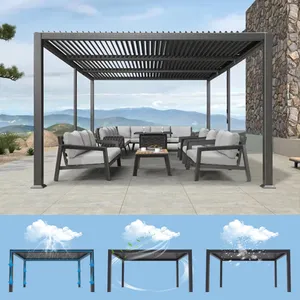
When the louvers are open, natural sunlight and fresh air can enter the space below. When partially adjusted, they provide balanced shade and ventilation. When completely closed, the blades create a protective roof surface that helps prevent rain from entering the covered area.
High quality aluminum louvers are usually manufactured from durable aluminum alloy profiles because the roof blades remain exposed to direct sunlight, rain, wind, and temperature changes throughout the year.
The main advantages of aluminum louvers include:
- Lightweight structure with excellent strength.
- High corrosion resistance for outdoor environments.
- Low maintenance requirements compared with wood structures.
- Modern appearance suitable for residential and commercial projects.
- Compatibility with motorized adjustment systems.
The design accuracy of the louver profile is also important because the blade shape affects waterproof performance, airflow efficiency, and overall appearance. A well-designed louver should rotate smoothly while maintaining proper alignment when closed.
Why are beams important in an Aluminum Louvered Pergola structure?
Beams are the main horizontal structural elements connecting the columns and supporting the roof system. Although they may appear simple from the exterior, beams perform several important functions at the same time.
First, beams distribute the weight of the aluminum louvers and mechanical components across the supporting columns. Second, they often contain integrated drainage channels that collect rainwater from the closed louver system. Third, they provide installation space for motors, lighting systems, and other accessories.
| Beam Function | Description |
| Structural Support | Transfers roof loads and improves frame stability |
| Drainage Management | Guides rainwater into hidden drainage channels |
| Accessory Integration | Provides space for lighting and control systems |
| Architectural Appearance | Creates clean modern exterior lines |
At Vionta Metal, our engineering team pays close attention to beam design because it directly affects both structural performance and visual quality. A well-designed beam should provide strength while maintaining the minimalist appearance expected from modern outdoor architecture.
What is the function of the column in an Aluminum Louvered Pergola?
The column is the primary vertical load-bearing component of an Aluminum Louvered Pergola. Every beam, louver, motor, and accessory ultimately transfers its weight to the columns before the load reaches the foundation. Because of this, the structural performance of the entire pergola depends heavily on the strength and precision of its columns.
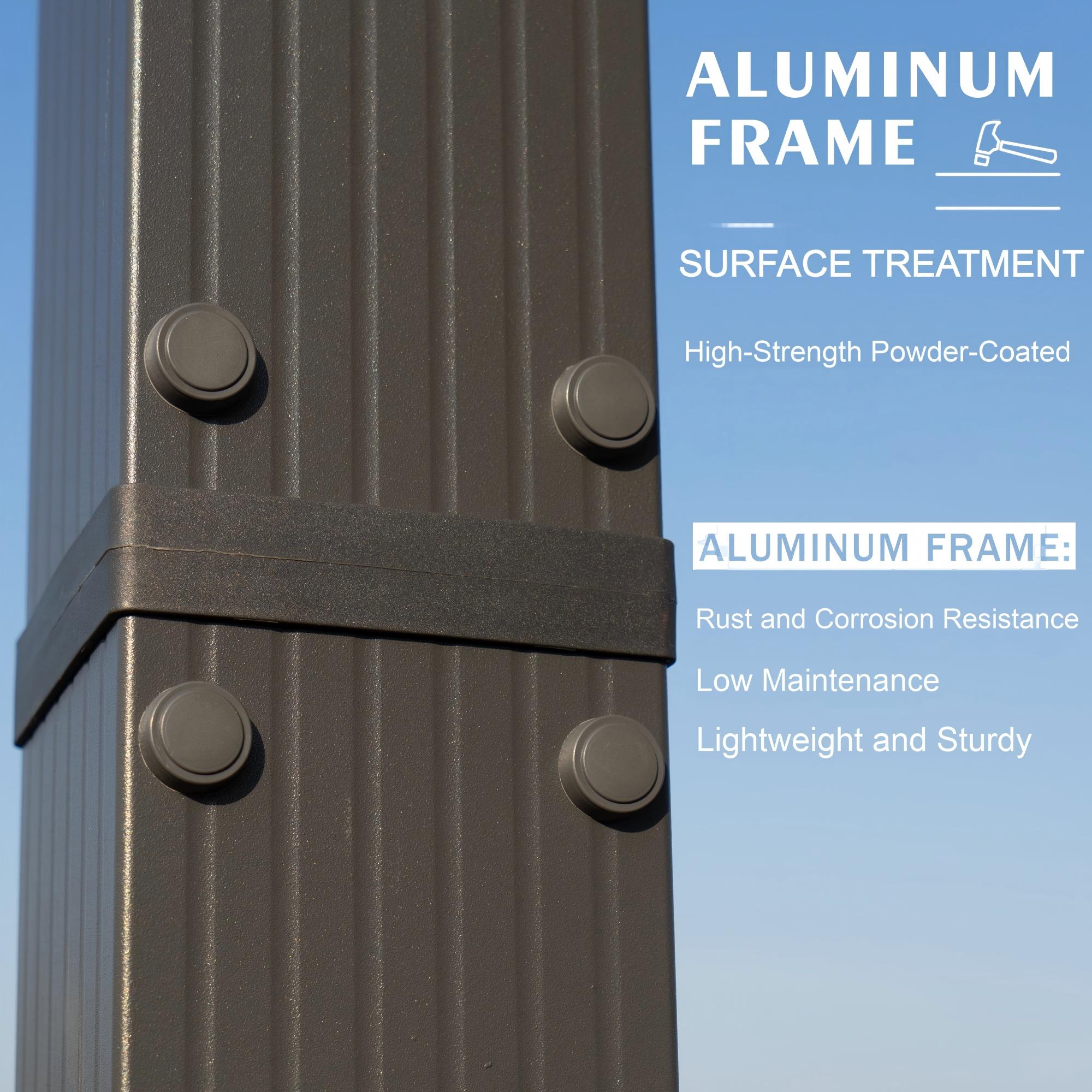
Modern pergola columns are manufactured from high-strength extruded aluminum profiles with reinforced internal chambers. This design provides excellent rigidity while keeping the overall structure lightweight. Compared with steel, aluminum columns offer superior corrosion resistance and require significantly less maintenance during long-term outdoor use.
Besides supporting the roof structure, columns also serve several concealed functions that improve both aesthetics and functionality.
- Hide rainwater drainage pipes inside the profile.
- Protect electrical wiring for LED lighting and motor systems.
- Provide clean installation for smart control cables.
- Maintain a minimalist appearance without exposed accessories.
From an engineering perspective, column dimensions should always match the size of the pergola. Larger commercial pergolas generally require stronger profiles than residential installations because they must withstand greater wind loads and roof spans.
| Column Feature | Engineering Benefit |
| Extruded Aluminum Profile | High strength with reduced weight |
| Internal Reinforcement | Improves structural rigidity |
| Hidden Drainage Channel | Keeps rainwater invisible |
| Cable Management | Protects electrical wiring |
At Vionta Metal, every column profile is engineered to balance structural performance with architectural appearance, allowing outdoor spaces to remain elegant without sacrificing strength.
Why is the mounting base essential for long-term structural stability?
Although the mounting base occupies only a small portion of the entire structure, it plays one of the most critical roles in ensuring safety. The mounting base connects the aluminum column directly to the concrete foundation, allowing the pergola to resist wind loads and maintain stability throughout years of outdoor exposure.
A professionally designed mounting base distributes structural forces evenly into the foundation while minimizing stress concentrations around anchor bolts.
Typical mounting base components include:
- Heavy-duty aluminum or steel base plate.
- Anchor bolts.
- Expansion anchors or chemical anchors.
- Protective decorative cover.
- Level adjustment during installation.
Proper installation of the mounting base is just as important as manufacturing quality. Even a perfectly engineered pergola can experience alignment issues if the foundation is not level or if anchor bolts are incorrectly positioned.
Our factory provides accurate installation drawings to help contractors achieve proper positioning before the pergola is assembled on site.
How does the aluminum angle plate improve louver operation?
One component that is often overlooked is the aluminum angle plate shown in the structural drawing. Although relatively small, this precision-machined connector is essential for transmitting movement between the motor system and the rotating aluminum louvers.
The aluminum angle plate performs several important functions simultaneously.
- Connects each aluminum blade securely.
- Transfers rotational force evenly.
- Maintains synchronization between adjacent louvers.
- Reduces unnecessary mechanical stress.
- Improves long-term operating reliability.
Because these components move every time the pergola operates, dimensional accuracy is extremely important. Small machining errors can eventually lead to uneven blade movement, increased operating noise, or additional wear on the transmission system.
For this reason, Vionta Metal uses precision processing methods to ensure every connection point maintains consistent movement throughout the entire roof assembly.
How does the motor connection system automate the pergola?
The motor connection system transforms a traditional pergola into a modern intelligent outdoor structure. Instead of manually adjusting every roof blade, users can operate all louvers simultaneously through a remote control, wall switch, or smart home integration.
As illustrated in the structural drawing, the motor connects directly to the aluminum angle plate and transmission mechanism. Once activated, rotational power is distributed evenly across every louver blade, ensuring synchronized movement.
The operating sequence follows a simple but highly engineered process.
- The user activates the control system.
- The motor generates rotational force.
- The transmission shaft transfers movement.
- The aluminum angle plates rotate together.
- Every louver reaches the same opening angle simultaneously.
This synchronized movement is essential because it ensures consistent appearance, proper waterproof sealing, and smooth operation.
| Motor Component | Purpose |
| Motor | Provides driving power |
| Transmission Shaft | Transfers rotational movement |
| Angle Plate | Connects motor to louvers |
| Control System | Operates the pergola remotely |
A premium motor system should provide quiet operation, stable torque, low maintenance requirements, and excellent reliability under continuous outdoor use.
Why is the integrated drainage structure one of the smartest engineering features?
One of the biggest advantages of an Aluminum Louvered Pergola is its hidden drainage system. When the roof blades close completely, rainwater flows naturally across the louver surfaces before entering concealed gutters inside the beams.
From there, water travels through internal drainage channels located inside the columns before exiting safely near the foundation. Because the entire drainage process occurs inside the structure, the pergola maintains a clean architectural appearance without visible pipes or external gutters.
This integrated design provides several advantages:
- Excellent rainwater management.
- Clean modern appearance.
- Reduced maintenance.
- Protection of surrounding outdoor furniture.
- Improved long-term durability.
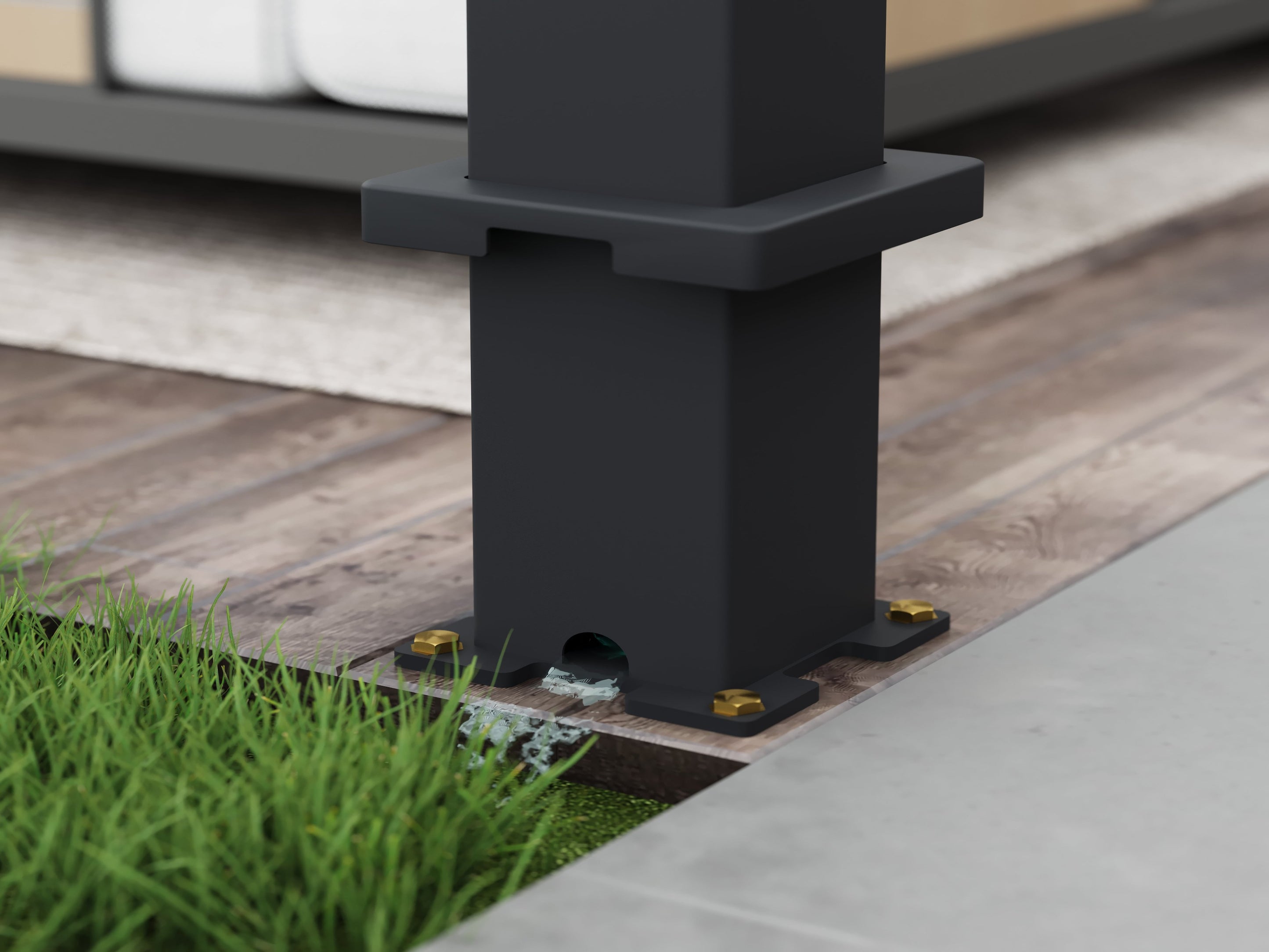
The drainage performance depends heavily on manufacturing precision. Accurate beam profiles, properly aligned louvers, and carefully engineered drainage channels all contribute to effective waterproof performance.
Why Does Each Component Matter for Aluminum Louvered Pergola Performance?
Every component inside an Aluminum Louvered Pergola has a specific engineering purpose. While individual parts such as the beam, column, louver, or mounting base each perform their own functions, the true value of the system comes from how these components work together. A pergola is only as strong as its weakest component, which is why manufacturers must pay equal attention to structural engineering, manufacturing precision, and material quality.
For architects and contractors, understanding the relationship between these components helps evaluate product quality beyond appearance. For distributors and project developers, it also provides a clearer understanding of long-term maintenance costs and overall investment value.
Why do aluminum louvers determine the comfort of the outdoor space?
The adjustable aluminum louver is the defining feature of the entire pergola. Unlike fixed roofs, rotating louvers allow users to regulate sunlight, airflow, and shade according to changing weather conditions.
During summer afternoons, partially opened louvers reduce direct solar radiation while allowing fresh air to circulate beneath the roof. During rainy weather, the blades rotate into a fully closed position to create a weather-resistant roof surface. On pleasant evenings, the louvers can be opened completely to provide an open-air outdoor experience.
This flexibility allows one outdoor structure to perform the functions of several traditional shading systems.
| Louver Position | Outdoor Effect |
| Fully Open | Maximum daylight and ventilation |
| Half Open | Balanced shade with airflow |
| Nearly Closed | Maximum shade while maintaining privacy |
| Fully Closed | Rain protection and waterproof roof |
Because the louvers move every day, they must maintain accurate alignment with minimal operating resistance. This depends on precision extrusion, accurate machining, and reliable connection hardware.
How do beams and columns create structural strength?
Although beams and columns are often viewed simply as structural supports, they actually form the load-bearing framework of the entire pergola. Together they resist gravity, wind pressure, and the dynamic forces generated during louver operation.
The engineering principle is straightforward:
- The aluminum louvers transfer loads to the beams.
- The beams distribute these loads evenly across the supporting columns.
- The columns transfer all structural forces into the concrete foundation through the mounting bases.
This continuous load path ensures structural stability even during demanding outdoor conditions.
High-quality beam profiles also reduce structural deflection over long spans, improving the appearance and long-term performance of the pergola.
Why does the motor system influence more than convenience?
Many buyers associate the motor only with automatic operation, but its influence extends much further. A properly matched motor protects the mechanical transmission system, improves synchronization between louvers, and reduces unnecessary wear on moving components.
Premium motor systems generally provide:
- Smooth blade rotation.
- Stable operating torque.
- Low operating noise.
- Long service life.
- Compatibility with smart controls.
- Reliable performance during frequent operation.
At Vionta Metal, motor selection is based on pergola dimensions, blade quantity, and projected operating loads rather than simply choosing a standard motor for every project.
How does the hidden drainage system improve waterproof performance?
One of the smartest engineering features shown in the structural drawing is the concealed drainage system. Unlike traditional patio covers with visible gutters, an Aluminum Louvered Pergola integrates water management directly into the structural framework.
When rainfall occurs, water follows a carefully designed path:
- Rainwater lands on the closed aluminum louvers.
- Each blade directs water toward the surrounding beam.
- Integrated gutters inside the beam collect the water.
- Hidden drainage channels inside each column transport water downward.
- Water exits safely through drainage outlets near the mounting base.
This concealed design keeps the pergola looking clean while protecting furniture, flooring, and nearby landscaping from uncontrolled runoff.
Why is precision manufacturing essential for long-term durability?
Many pergolas look similar when viewed from a distance, but manufacturing precision determines how well they perform after years of outdoor use. Accurate profile dimensions, clean machining, consistent coatings, and precise assembly all contribute to smoother operation and greater structural reliability.
At Vionta Metal, manufacturing quality is controlled throughout the production process. Each structural component is inspected before assembly to ensure dimensional consistency and proper fit.
| Manufacturing Stage | Quality Objective |
| Raw Material Inspection | Ensure aluminum profile quality |
| Precision Machining | Maintain dimensional accuracy |
| Powder Coating | Improve corrosion resistance |
| Assembly Inspection | Verify component compatibility |
| Operation Testing | Confirm smooth louver movement |
Consistent production standards reduce installation adjustments and improve customer satisfaction across residential and commercial projects.
The structural drawing demonstrates that every part of an Aluminum Louvered Pergola serves a meaningful engineering purpose. From the aluminum louvers above to the mounting bases below, each component contributes to strength, weather resistance, operational reliability, and long-term durability. Understanding these relationships enables buyers to evaluate pergolas based on engineering quality rather than appearance alone.
How Does an Aluminum Louvered Pergola Work as a Complete Outdoor System?
An Aluminum Louvered Pergola is designed as a fully integrated outdoor system rather than a collection of independent components. Every part shown in the structure drawing—from the aluminum louvers and beams to the columns, motor connection system, and concealed drainage channels—works together to create a comfortable, weather-resistant, and visually appealing outdoor living space.
When one component moves, several other components respond simultaneously. This coordinated operation is what distinguishes a premium pergola from a conventional fixed patio cover. Instead of providing only permanent shade, the system adapts to changing weather conditions while maintaining structural stability and architectural elegance.
How do the aluminum louvers open and close?
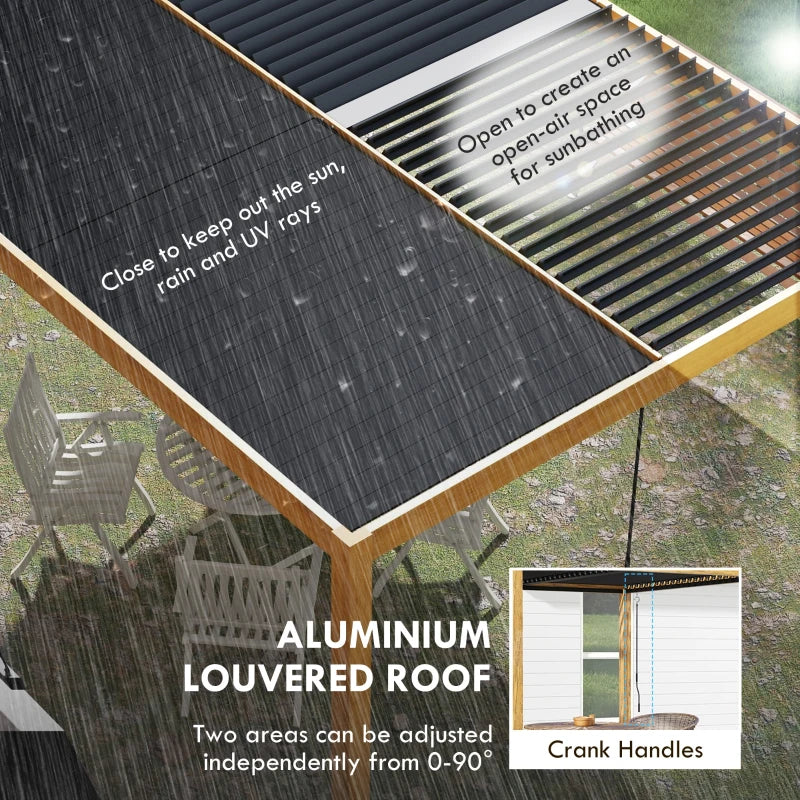
The adjustable aluminum louvers are the dynamic element of the pergola. As illustrated in the structure drawing, every blade is connected through aluminum angle plates and synchronized linkage components. Once the motor is activated, all louvers rotate simultaneously to the same angle, creating a clean and uniform appearance.
Different blade positions provide different environmental conditions beneath the pergola.
| Blade Position | Performance | Recommended Situation |
| Fully Open | Maximum ventilation and daylight | Cool mornings and pleasant evenings |
| 30° to 60° | Balanced shade and airflow | Daily outdoor activities |
| Nearly Closed | Strong sun protection | Hot summer afternoons |
| Fully Closed | Rainproof roof | Rainy weather |
This flexibility allows homeowners and commercial users to create a comfortable outdoor environment throughout different seasons without adding separate shade systems.
How does the motor drive every louver at the same time?
One of the most impressive engineering features of an Aluminum Louvered Pergola is its synchronized movement. Although dozens of aluminum blades rotate together, only one motor is generally required for each pergola module.
The operating process follows a carefully engineered sequence.
- The user presses the remote control, wall switch, or smart control system.
- The tubular motor begins rotating.
- Rotational force is transferred through the transmission shaft.
- The aluminum angle plates move together.
- Every aluminum louver rotates simultaneously.
- The blades stop automatically at the selected opening angle.
This synchronized movement minimizes mechanical stress while ensuring smooth operation and consistent waterproof sealing when the roof closes.
At Vionta Metal, every motorized system is tested before shipment to verify smooth operation, synchronized blade movement, and reliable performance.
How does the hidden drainage system work during rainfall?
Rain protection is another important advantage of an Aluminum Louvered Pergola. Unlike traditional pergolas, the adjustable roof can become a waterproof surface when all blades are completely closed.
The drainage process is fully integrated into the structure.
- Rainwater lands on the closed aluminum louvers.
- Special blade profiles guide water toward both sides of the roof.
- Integrated gutters inside the beams collect the water.
- Hidden drainage channels inside the columns transport the water downward.
- Water exits through outlets located near the mounting bases.
Because the entire drainage system is concealed inside the aluminum profiles, the pergola maintains a clean and minimalist appearance without exposed pipes or gutters.
This hidden drainage design also protects outdoor furniture, flooring, and surrounding landscaping from uncontrolled rainwater runoff.
Why is integrated LED lighting becoming a standard feature?
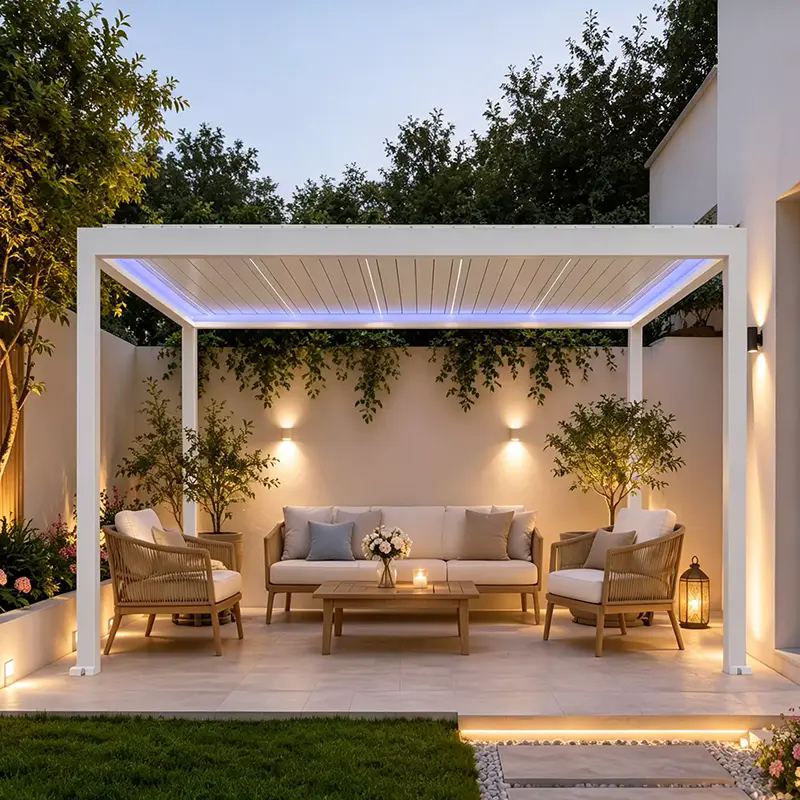
The structure drawing also illustrates an LED light strip installed beneath the beam. Modern outdoor living spaces are increasingly expected to function during the evening as well as during daylight hours.
Integrated LED lighting provides several advantages.
- Creates a comfortable atmosphere for outdoor dining.
- Improves nighttime visibility.
- Enhances architectural aesthetics.
- Maintains a clean appearance through concealed wiring.
- Supports smart lighting control systems.
Unlike surface-mounted lighting fixtures, integrated light strips are installed inside specially designed beam profiles. This protects the lighting system from outdoor weather while preserving the modern appearance of the pergola.
How do all structural components work together?
Every component shown in the structural drawing contributes to the overall performance of the pergola.
| Component | Primary Responsibility | Contribution to Overall Performance |
| Aluminum Louver | Shade and ventilation | Controls outdoor comfort |
| Beam | Structural support | Supports roof and drainage |
| Column | Vertical load transfer | Maintains structural stability |
| Mounting Base | Foundation connection | Improves wind resistance |
| Aluminum Angle Plate | Mechanical connection | Ensures synchronized movement |
| Motor System | Automatic operation | Provides intelligent control |
| Drainage System | Rainwater management | Maintains waterproof performance |
| LED Light Strip | Outdoor illumination | Extends usability after sunset |
This integrated engineering approach is why modern aluminum pergolas have become one of the most popular outdoor architectural solutions for villas, hotels, restaurants, resorts, rooftop terraces, and commercial developments.
Rather than functioning as separate parts, every component supports the others. Strong columns stabilize the beams, beams support the louvers, the motor controls the louver movement, the drainage system manages rainwater, and the lighting system enhances the outdoor experience. Together they create a durable, intelligent, and elegant outdoor structure capable of performing throughout the year.
What Should Buyers Consider When Choosing an Aluminum Louvered Pergola Manufacturer?
Choosing the right Aluminum Louvered Pergola manufacturer is just as important as selecting the right product. While many suppliers offer pergolas with a similar appearance, significant differences exist in engineering capability, material quality, manufacturing precision, and project support. A well-designed pergola should provide reliable performance for many years, making the manufacturer's experience and production standards key factors in your purchasing decision.
Whether you are an architect designing a luxury villa, a contractor managing a commercial project, or a distributor sourcing products for your local market, evaluating a manufacturer beyond price alone will help ensure long-term value and customer satisfaction.
What material quality should you evaluate?
The foundation of every high-performance Aluminum Louvered Pergola begins with premium raw materials. High-grade aluminum alloy provides an excellent balance of strength, corrosion resistance, and lightweight construction, making it ideal for long-term outdoor applications.
When comparing suppliers, consider the following material characteristics:
| Inspection Item | Why It Matters |
| Aluminum Alloy Grade | Improves structural strength and corrosion resistance |
| Profile Thickness | Enhances stability and load-bearing capacity |
| Powder Coating Quality | Provides long-lasting weather resistance and color stability |
| Hardware Components | Ensures reliable operation of moving parts |
| Motor System | Determines operating smoothness and service life |
High-quality materials not only improve durability but also reduce maintenance costs throughout the life of the pergola.
How important are customization capabilities?
Every outdoor project is unique. Residential villas, rooftop terraces, hotel courtyards, restaurants, swimming pools, and commercial plazas all require different pergola configurations. A professional manufacturer should therefore provide flexible customization services.
Common customization options include:
- Custom dimensions.
- Single or multiple module configurations.
- Different powder-coated colors.
- Integrated LED lighting.
- Motorized ZIP screens.
- Sliding glass doors.
- Wind and rain sensors.
- Smart home control integration.
Customization allows architects and developers to create outdoor spaces that perfectly match the surrounding building style while meeting specific functional requirements.
Why should you choose Vionta Metal?
At Vionta Metal, we specialize in designing and manufacturing premium aluminum outdoor living solutions for customers worldwide. Our engineering team focuses on structural performance, product reliability, and modern architectural aesthetics, providing customized solutions for residential and commercial applications.
Our advantages include:
- Professional aluminum fabrication experience.
- Integrated product design and manufacturing.
- OEM and ODM services.
- Strict production quality control.
- Experienced international export support.
- Flexible customization capabilities.
- Technical assistance before and after the project.
From product consultation and engineering support to production and delivery, Vionta Metal works closely with architects, contractors, distributors, and developers to deliver reliable Aluminum Louvered Pergola solutions that combine functionality, durability, and contemporary design.
Request a Professional Aluminum Louvered Pergola Solution
Planning a residential, commercial, or hospitality project? Let the experienced team at Vionta Metal help you find the right Aluminum Louvered Pergola solution for your application.
We provide professional product recommendations, customized engineering solutions, OEM and ODM manufacturing, and complete technical support to help you create high-quality outdoor spaces that stand the test of time.
Contact our team today to discuss your project requirements and discover how our customized Aluminum Louvered Pergola systems can add lasting value to your next development.
Frequently Asked Questions
What are the main parts of an Aluminum Louvered Pergola?
The main parts include aluminum louvers, beams, columns, mounting bases, aluminum angle plates, motor systems, hidden drainage channels, and optional accessories such as LED lighting and ZIP screens. Each component contributes to the structural stability, weather resistance, and overall performance of the pergola.
Why are adjustable aluminum louvers better than a fixed roof?
Adjustable louvers provide flexible control over sunlight, ventilation, and rain protection. Users can easily change the blade angle to create comfortable outdoor conditions throughout the day, making the pergola more versatile than a traditional fixed-roof structure.
How does an Aluminum Louvered Pergola stay waterproof?
When the louvers close completely, rainwater flows into integrated gutters concealed inside the beams. The water then travels through hidden drainage channels inside the columns before exiting near the foundation, creating an efficient and discreet drainage system.
How long does an Aluminum Louvered Pergola typically last?
A professionally manufactured Aluminum Louvered Pergola made from high-quality aluminum alloy and finished with a durable powder coating can provide decades of outdoor service with minimal maintenance. Regular cleaning and periodic inspections help maximize its lifespan.
How do I choose the right Aluminum Louvered Pergola manufacturer?
Look for manufacturers with strong engineering capabilities, high-quality materials, advanced production equipment, strict quality control, customization services, and international project experience. These factors are often more important than price alone when evaluating long-term value.
Related News
- Are Jalousie Windows Easy to Break Into?
- Is Stainless Steel Glass Railing Safe?
- How waterproof is an aluminum louvered pergola during heavy rain, and how should its drainage capacity be tested?
- How Strong Is Aluminum Railing Compared With Steel Railing?
- How to Choose Metal Railing for Residential and Commercial Projects
- How To Remove Hard Water Stains From Glass Railings?
Leave me a message