How to Mount a Metal Privacy Screen on Concrete?
Installing a metal privacy screen on concrete is a practical way to create privacy around a patio, garden, pool area, balcony, or commercial outdoor space. Unlike installation on soil, mounting a screen on an existing concrete slab allows you to avoid digging post holes, provided the concrete is suitable for the required anchoring system.
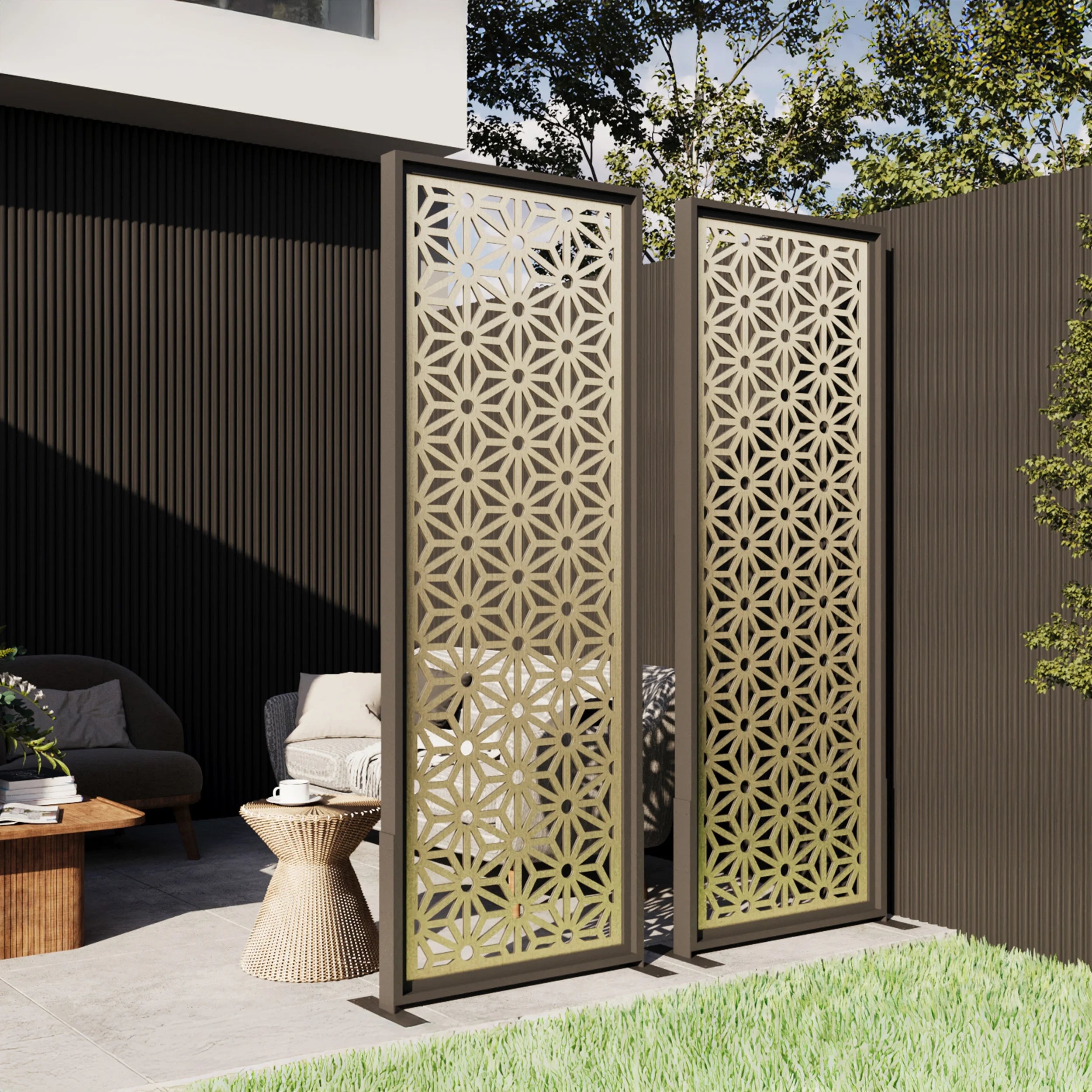
However, a secure installation involves more than drilling a few holes and tightening bolts. The concrete must be capable of supporting the screen, the mounting base must match the post design, and the anchors must be selected according to the installation conditions and expected loads.
For a galvanized steel privacy screen, these details are particularly important when installing tall panels, joining multiple screens, or placing the structure in an exposed outdoor area.
In this guide, we explain how to mount a metal privacy screen on concrete, which mounting hardware to consider, how to avoid common installation problems, and what to confirm before ordering a custom screen from a manufacturer.
Table of Contents
- 1. What Is the Best Way to Mount a Metal Privacy Screen on Concrete?
- 2. What to Check Before Installing a Privacy Screen
- 3. Tools and Materials You May Need
- 4. How to Install a Metal Privacy Screen on Concrete: Step by Step
- 5. How to Choose Concrete Anchors for a Metal Privacy Screen
- 6. How to Keep a Metal Privacy Screen Stable in Wind
- 7. Common Installation Mistakes to Avoid
- 8. What to Specify When Ordering a Custom Metal Privacy Screen
- 9. Frequently Asked Questions
1. What Is the Best Way to Mount a Metal Privacy Screen on Concrete?
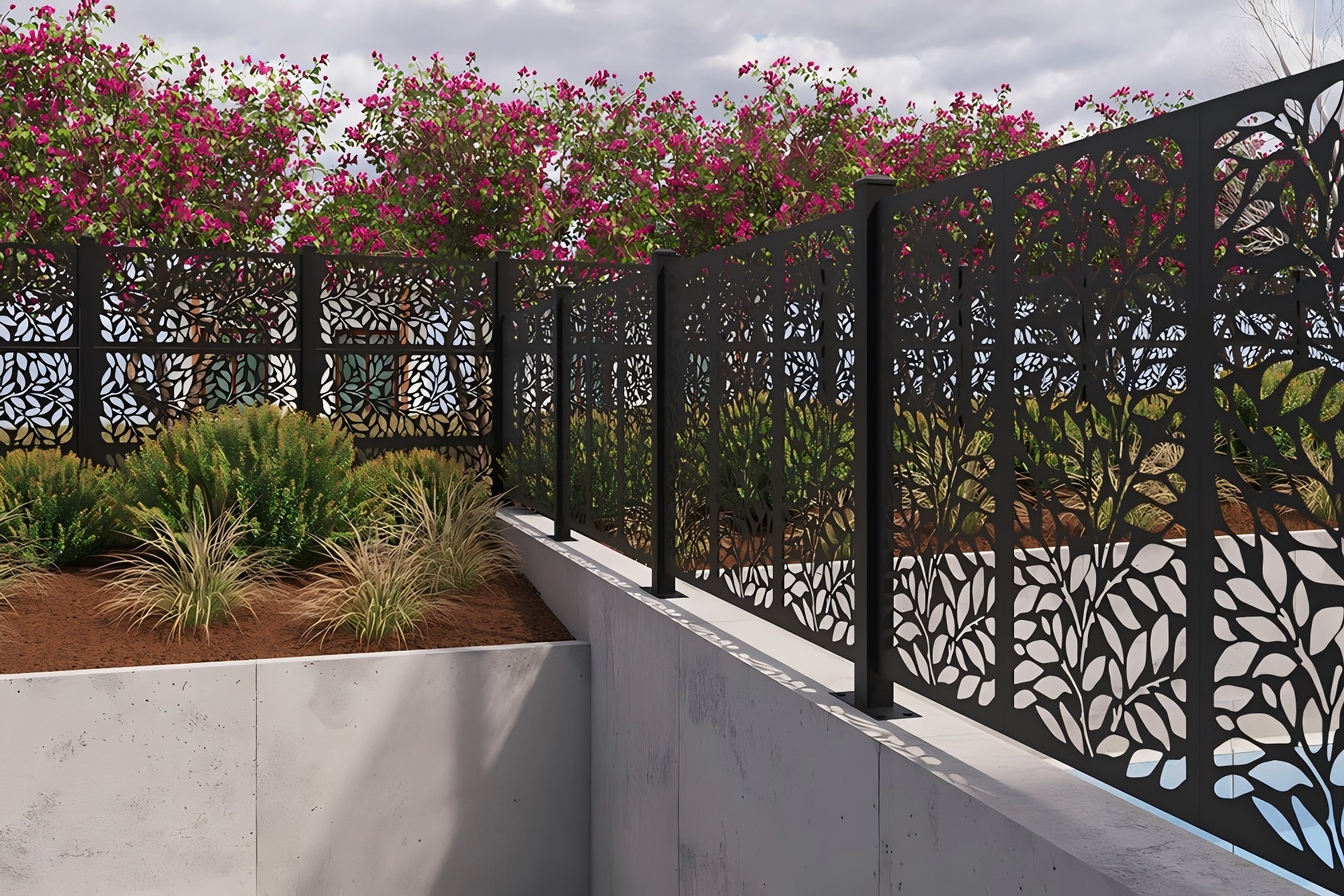
For most installations on a suitable existing concrete slab, surface mounting with base plates is a practical option. The support posts are secured to the concrete through mounting plates, and the screen panels are then attached to the posts or frames.
The appropriate mounting method depends on the screen design, panel dimensions, installation location, and condition of the supporting structure.
Surface-Mounted Base Plates
Surface mounting uses a metal base plate attached to the bottom of a support post. The plate has holes for the specified concrete anchors, allowing the post to be secured to an existing slab without burying it in the ground.
This method is commonly considered for:
- Concrete patios and outdoor seating areas.
- Garden boundaries with existing concrete foundations.
- Poolside privacy partitions.
- Commercial landscaping and outdoor dining areas.
- Suitable balcony and terrace structures.
The main advantage is that installation can take place on an existing concrete surface without excavating individual post holes. The finished appearance can also be relatively clean when the base plates and fasteners are coordinated with the screen design.
However, surface mounting transfers the screen loads directly to the concrete anchors and supporting slab. A thin, cracked, or structurally unsuitable concrete surface may not provide adequate support.
Post Installation in New Concrete Footings
If the existing concrete cannot provide suitable anchorage, another option may be to install new structural footings and embed the support posts in concrete. This approach involves more excavation and construction work, but it may be appropriate for certain freestanding screens or sites without a suitable existing slab.
Footing dimensions and post embedment depth should not be selected from a universal rule of thumb. They depend on the screen height, wind exposure, soil conditions, post design, and local requirements.
Which Mounting Method Should You Choose?
| Mounting method | Typical application | Main consideration |
| Surface-mounted base plate | Existing concrete patio or suitable concrete slab | Concrete strength, slab condition, anchor capacity, and base plate design |
| Posts embedded in new concrete footings | Garden boundaries or locations requiring new foundations | Excavation, footing design, drainage, and soil conditions |
| Engineered structural support | Elevated terraces or installations with special structural constraints | Load transfer, waterproofing, building structure, and professional approval |
For many renovation projects, surface-mounted base plates are worth considering first because they can simplify installation on an existing slab. The final choice should still be based on the actual site conditions and structural requirements.
2. What to Check Before Installing a Privacy Screen
Before purchasing mounting hardware or drilling into concrete, inspect the installation area. Problems discovered at this stage are generally easier to address than problems found after the screen has been assembled.
Check the Concrete Condition
The supporting concrete should be sound and suitable for the selected anchoring system. Look for significant cracks, spalling, loose surface material, damaged edges, or signs of movement.
Do not assume that a concrete patio, decorative concrete topping, or paving surface can automatically support a tall metal screen. The visible surface may be relatively thin or may sit above a different underlying structure.
If the concrete condition or construction is uncertain, have it assessed before installation. Anchor selection should account for the actual concrete substrate rather than just the appearance of the finished surface.
Confirm the Screen Dimensions and Layout
The height and width of the screen influence the mounting requirements. A tall, wide panel can create substantial wind loads, even when it is made from relatively thin sheet metal.
Before installation, confirm:
- The overall height and width of each panel.
- The number of panels and support posts.
- The required spacing between posts.
- The location and dimensions of the mounting base plates.
- Whether adjacent panels require connecting brackets.
- Whether the panels have solid surfaces or decorative openings.
For a custom project, Vionta Metal can manufacture galvanized steel privacy screens to specified dimensions and designs. Confirming the mounting layout before production helps ensure that the panel dimensions, post positions, and connection details work together.
Locate Hidden Utilities and Reinforcement
Before drilling, check for embedded electrical conduits, plumbing, heating lines, and other concealed services. Reinforcing steel may also be present inside the concrete.
Use appropriate detection methods and follow the relevant site procedures. If the proposed anchor positions conflict with reinforcement or embedded services, the layout may need to be reviewed by the responsible installer or engineer.
Consider Drainage and Surface Slope
Outdoor concrete surfaces are often sloped to direct rainwater away from buildings. Check whether the proposed base plate can sit correctly on the surface and whether the post can remain vertical.
Do not correct a sloping surface by arbitrarily stacking loose washers beneath the base plate. Where leveling is necessary, use a suitable engineered detail that maintains proper bearing and anchor performance.
3. Tools and Materials You May Need
The exact tools and hardware depend on the mounting system, concrete condition, and screen design. For a typical surface-mounted installation, the following items may be required.
| Item | Purpose |
| Metal privacy screen panels and support posts | Form the screen assembly. |
| Base plates and mounting brackets | Connect the support posts to the concrete and panels to the supporting structure. |
| Specified concrete anchors | Secure the base plates to suitable concrete. |
| Hammer drill and compatible drill bits | Create anchor holes where the selected anchoring system requires drilling. |
| Tape measure and marking tools | Measure panel positions and mark anchor locations. |
| Spirit level | Check post alignment and vertical position. |
| Suitable cleaning equipment | Remove drilling debris from anchor holes according to the anchor manufacturer's instructions. |
| Specified tightening tools | Tighten the anchors and assembly fasteners as required. |
| Appropriate personal protective equipment | Protect installers during drilling, lifting, and assembly. |
For structural anchors, follow the manufacturer's instructions regarding hole diameter, drilling depth, hole cleaning, edge distance, embedment, and tightening torque. Adhesive anchors may also have specific requirements for temperature, curing time, and hole preparation.
Do not substitute a convenient fastener for the specified anchor simply because it fits through the base plate.
4. How to Install a Metal Privacy Screen on Concrete: Step by Step
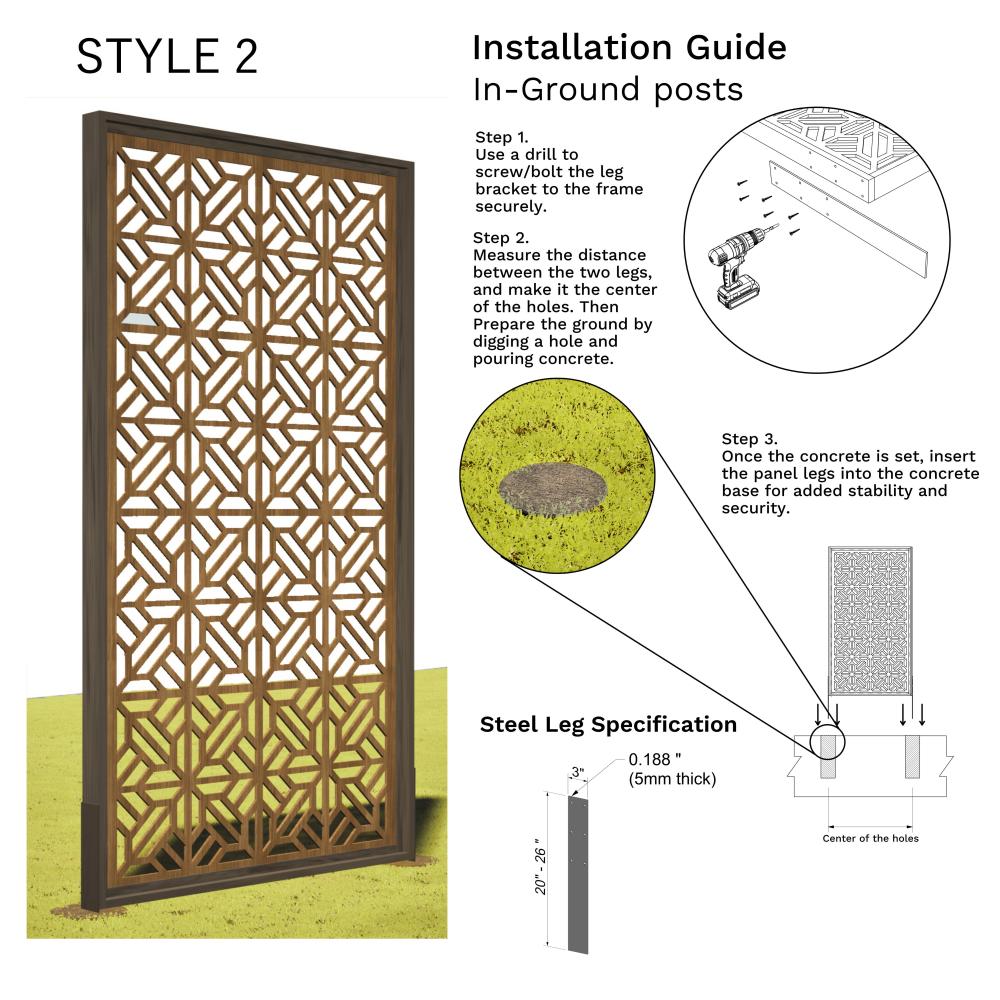
Once the concrete has been checked and the mounting system selected, installation can proceed. The following steps describe a typical surface-mounted arrangement. The actual sequence should follow the supplied installation drawings and hardware instructions.
Step 1: Mark the Screen Position
Determine the finished position of the privacy screen before drilling any holes.
Measure the overall installation length and mark the locations of the support posts. Check the distance between adjacent posts against the actual panel and connection dimensions.
For multiple panels, establish a straight reference line. This helps prevent the screen from gradually drifting out of alignment along its length.
Also check access requirements, nearby doors, drainage paths, and any building features that could interfere with installation.
Step 2: Position the Base Plates
Place each base plate at its marked location and verify that the plate sits correctly on the supporting concrete.
Check the orientation of the plate, the position of its anchor holes, and the clearance around the post. If the base plate is welded to the post, confirm that the post can be positioned correctly without interfering with nearby walls or other structures.
For custom screens, the base plate dimensions and hole arrangement should be confirmed before fabrication. This is particularly important when the available concrete area is limited or when the posts must fit around existing architectural features.
Step 3: Mark and Drill the Anchor Holes
Use the base plate to mark the required anchor positions. Remove the plate before drilling, unless the approved installation procedure specifies otherwise.
Drill the holes using the diameter and depth required by the selected anchor system. Keep the holes correctly positioned and avoid drilling too close to concrete edges or existing cracks.
Before drilling, verify that the proposed locations do not conflict with embedded services or reinforcement. If the required edge distances cannot be achieved, stop and review the anchoring design rather than moving holes without checking the consequences.
Step 4: Clean the Holes and Install the Anchors
Drilling leaves dust and debris inside the holes. Remove this material using the cleaning method specified by the anchor manufacturer.
Install the selected concrete anchors according to their instructions. Different anchor types have different installation requirements, so the procedure for one product should not automatically be applied to another.
For example, mechanical expansion anchors rely on the specified installation and expansion process, while adhesive anchors require compatible adhesive, correct hole preparation, and the required curing time.
Do not apply the final tightening torque until the anchor manufacturer's installation procedure allows it.
Step 5: Secure the Base Plates
Position the base plates over the prepared anchor locations and install the specified fasteners.
Check that each plate bears properly against the concrete and that the post remains aligned. Tighten the anchors according to the specified procedure and torque requirements.
Do not overtighten the anchors in an attempt to make an unsuitable concrete surface more secure. Excessive or incorrect tightening can damage the connection or compromise the anchoring system.
Step 6: Attach the Metal Privacy Screen Panels
Once the posts and base plates are secured, attach the privacy screen panels using the designated brackets, bolts, or other connection hardware.
For laser-cut galvanized steel screens, confirm that the decorative pattern faces the intended direction and that the panel orientation matches the approved drawings.
When installing several panels, work progressively along the reference line. Check the height, spacing, and vertical alignment of each panel before fully tightening its connections.
Depending on the product design, adjacent panels may connect directly to shared posts or use separate connection brackets. Follow the actual assembly design rather than assuming every screen uses the same arrangement.
Step 7: Check Alignment and Connection Security
After assembly, inspect the complete installation.
- Confirm that the posts are vertical and the panels are correctly aligned.
- Check that all specified fasteners are installed.
- Verify that base plates sit correctly on the concrete.
- Inspect the panels for movement, distortion, or installation damage.
- Confirm that any protective finish damaged during installation has been addressed using the approved repair procedure.
Do not rely on a simple hand-push test as proof that a tall screen can withstand design wind loads. Where structural performance is critical, the installation must satisfy the applicable engineering requirements.
5. How to Choose Concrete Anchors for a Metal Privacy Screen
Choosing the right concrete anchor is one of the most important decisions when mounting a metal privacy screen. The anchor must work with the actual concrete substrate, base plate, applied loads, and outdoor environment.
Mechanical Expansion Anchors
Mechanical expansion anchors are commonly used for suitable concrete installations. They expand or engage with the surrounding concrete when installed according to the manufacturer's procedure.
They may be appropriate for base plates where the concrete quality, thickness, edge distances, anchor spacing, and load requirements fall within the anchor's approved application.
Concrete Screws
Concrete screws engage with a prepared hole in suitable concrete. They can be useful for certain surface-mounted applications, but the correct product, embedment depth, and installation method must be verified.
A concrete screw is not automatically suitable for every privacy screen. The anchor must have adequate capacity for the actual connection and loading conditions.
Adhesive Anchors
Adhesive anchoring systems use a specified resin to bond an anchor rod or other approved element into a prepared hole.
They may be considered when the design calls for an adhesive system, but performance depends on correct hole preparation, installation conditions, curing time, and the approved application. Some installations also require specific qualifications or inspections.
What Determines the Correct Anchor?
| Factor | Why it matters |
| Concrete strength and condition | Anchors require a suitable substrate to develop their intended capacity. |
| Slab thickness | The available concrete depth affects the permissible anchor type and embedment. |
| Anchor edge distance | Anchors too close to an edge may increase the risk of concrete breakout. |
| Screen height and width | Larger panels can generate greater wind-induced forces at the mounting connection. |
| Base plate design | Plate dimensions, thickness, hole positions, and post connections affect load transfer. |
| Outdoor exposure | Moisture, coastal conditions, and contact between dissimilar metals influence fastener selection. |
For a tall or heavily exposed screen, the anchor arrangement should be checked as part of the complete structural connection. Simply increasing the anchor diameter does not necessarily solve problems involving inadequate concrete, poor edge distances, or an undersized base plate.
When planning a project with Vionta Metal, provide the screen dimensions, installation location, and details of the concrete substrate so the appropriate mounting arrangement can be discussed before production.
6. How to Keep a Metal Privacy Screen Stable in Wind
A metal privacy screen can act like a sail when wind pushes against its surface. The resulting force is transferred through the panel connections, support posts, base plates, anchors, and concrete structure.
This is why a screen that appears stable in calm weather may still require careful structural consideration in an exposed location.
Consider Panel Height and Opening Pattern
Screen height, width, and surface area all influence wind loading. Decorative laser-cut patterns can allow some air to pass through, but the effect depends on the opening ratio, pattern geometry, wind direction, and other design factors.
Do not assume that a perforated or laser-cut panel automatically meets a particular wind-resistance requirement. Performance should be evaluated for the actual panel design and installation conditions.
Use a Suitable Post and Base Plate Design
The support posts and base plates must be designed to transfer the expected loads to the supporting structure.
A large panel mounted on a small base plate may create excessive demands on the connection. Similarly, strong anchors cannot compensate for an inadequately designed post or a weak concrete substrate.
For larger screens, confirm the post dimensions, panel attachment method, base plate configuration, and anchor layout together.
Check the Concrete Before Installation
Cracked concrete, thin slabs, unsupported edges, and decorative paving layers can limit the reliability of surface mounting.
If a privacy screen is being installed on a rooftop, elevated terrace, or retaining wall, the supporting structure may require additional assessment. A rooftop installation also needs careful consideration of the waterproofing system and the consequences of drilling through it.
Plan for Inspection and Maintenance
After installation, periodically inspect the mounting hardware and visible connections. Check for loose fasteners, corrosion, damaged coatings, movement, or cracking around the anchors.
Follow the anchor manufacturer's inspection recommendations and the project's maintenance requirements. If movement or structural damage appears, restrict access where necessary and arrange a competent assessment before continuing to use the installation.
7. Common Installation Mistakes to Avoid
Many privacy screen installation problems can be avoided by confirming the mounting design before the panels reach the site.
Drilling into Concrete Without Checking Its Condition
Not every concrete surface is suitable for anchoring a tall metal screen. A decorative topping or individual paving stone should not be treated as equivalent to a structurally adequate concrete slab.
Identify the actual supporting material and verify its suitability before drilling.
Choosing Anchors Based Only on Price or Diameter
A larger or more expensive anchor is not necessarily the right choice. The anchor type, embedment, edge distance, spacing, substrate, and applied loads must all be considered.
Use an approved anchoring system that matches the installation requirements.
Installing Panels Before Checking Post Spacing
If the post spacing does not match the panel dimensions and connection design, installers may struggle to align adjacent panels or fit the connection hardware correctly.
Confirm the panel schedule, post locations, and mounting drawings before drilling the first hole.
Ignoring Corrosion at the Connections
Galvanized steel provides corrosion protection through its zinc coating, but the entire assembly still needs appropriate material selection and finishing.
Outdoor fasteners should be suitable for the exposure conditions. Contact between dissimilar metals, damaged coatings, and persistent moisture can contribute to corrosion problems.
Where the galvanized finish or powder coating is damaged during installation, use a suitable repair procedure recommended for the specified coating system.
Assuming All Concrete Slabs Can Support the Same Screen
A short decorative partition on a sheltered patio does not create the same demands as a tall privacy screen exposed to strong winds.
Do not apply one universal anchor size, slab thickness, or base plate dimension to every installation. Structural requirements should be established for the actual project.
8. What to Specify When Ordering a Custom Metal Privacy Screen
For contractors, landscape designers, distributors, and project buyers, installation requirements should be discussed with the manufacturer before production begins.
A screen may have the right dimensions and appearance but still require on-site modifications if the base plates, support posts, or panel connections do not match the intended installation.
At Vionta Metal, galvanized steel privacy screens can be customized for different outdoor applications. Preparing the following information helps clarify the product configuration and mounting requirements.
1. Panel Dimensions and Quantity
Provide the finished panel height, width, quantity, and overall installation length. For projects involving multiple sections, include the desired post spacing and any corners or changes in direction.
If the project uses imperial dimensions, such as feet and inches, confirm the final production dimensions before manufacturing.
2. Material and Surface Finish
Specify the required galvanized steel construction and whether an additional powder-coated finish is needed. Color requirements can include a standard color reference or a project-specific finish.
For coastal or other demanding environments, discuss the expected exposure conditions and the appropriate corrosion-protection system with the manufacturer.
3. Mounting Method
Tell the supplier whether the screen will be surface-mounted on concrete, installed using new footings, attached to a wall, or integrated into an existing frame.
For concrete installations, provide available information about the slab thickness, concrete condition, edge locations, and any restrictions on drilling.
4. Base Plates and Connection Details
Confirm whether the project requires welded base plates, separate mounting brackets, pre-drilled holes, or specific panel-to-post connections.
For projects with restricted installation space, send a drawing showing the available mounting area and the desired post locations.
5. Project Drawings and Installation Requirements
Provide architectural drawings, CAD files, sketches, reference photos, or a written project brief. These details help the manufacturer understand the intended appearance and assembly arrangement.
Vionta Metal supports OEM and ODM customization for metal privacy screens, including panel dimensions, decorative patterns, and finish options. Mounting details should be reviewed alongside the screen design so that the manufactured components match the intended installation approach.
For projects with demanding wind conditions or unusual supporting structures, the final anchor and foundation design should be confirmed by the responsible engineer or qualified installation professional.
What Should You Send When Requesting a Quote?
- Required panel dimensions and total quantity.
- Preferred galvanized steel finish and color.
- Decorative pattern or reference design.
- Photos or drawings of the concrete installation area.
- Preferred mounting method and any site restrictions.
- Project location and relevant environmental conditions.
- Required accessories, posts, base plates, and connection hardware.
Providing this information at the quotation stage helps reduce uncertainty about the product configuration and makes it easier to coordinate manufacturing with site installation.
If you are sourcing a galvanized steel privacy screen for a residential, commercial, or landscape project, contact Vionta Metal to discuss your drawings, panel dimensions, finish requirements, and mounting preferences.
Explore Vionta Metal Galvanized Steel Privacy Screens
9. Frequently Asked Questions
Can you mount a metal privacy screen directly onto concrete?
Yes. A metal privacy screen can often be mounted on a suitable concrete slab using support posts with base plates and compatible concrete anchors. The slab must be structurally adequate for the screen and its expected loads. Check the concrete condition, thickness, edge distances, and anchor requirements before installation.
Do I need to drill holes to install a privacy screen on concrete?
For a conventional surface-mounted installation with mechanical anchors or concrete screws, drilling is generally required. Some freestanding systems use weighted bases, but their suitability depends on the screen dimensions, wind exposure, and site conditions. A non-penetrating base should not be assumed safe without checking its stability.
What type of concrete anchors should I use for a metal privacy screen?
Suitable options may include mechanical expansion anchors, concrete screws, or approved adhesive anchoring systems. The correct choice depends on the concrete substrate, base plate design, anchor spacing, edge distances, outdoor exposure, and expected loads. Follow the selected anchor manufacturer's installation requirements.
Can a galvanized steel privacy screen be installed on an existing concrete patio?
Yes, provided the patio and its supporting structure are suitable for the installation. Check for cracks, insufficient thickness, unsupported edges, and concealed utilities before drilling. For a tall screen or an exposed location, the anchor arrangement and concrete capacity may need professional assessment.
How do you prevent a metal privacy screen from wobbling?
Start with a suitable supporting structure, correctly designed posts and base plates, and anchors installed according to their specifications. Check the panel connections and post alignment during assembly. If the screen continues to move, do not simply tighten the bolts further; investigate the concrete, anchors, post stiffness, and overall structural design.
Conclusion
Mounting a metal privacy screen on concrete can be a practical solution for patios, gardens, pool areas, and commercial outdoor spaces. Surface-mounted base plates are often a convenient option when an existing concrete slab is suitable for anchoring.
A reliable installation begins with the right mounting method, a sound concrete substrate, compatible anchors, and properly coordinated posts and panels. Wind exposure and the supporting structure also need to be considered, especially for tall screens or elevated installations.
For custom projects, resolving these details before manufacturing can help reduce on-site adjustments and installation delays.
Vionta Metal manufactures galvanized steel privacy screens with customizable dimensions, decorative patterns, and surface finishes for residential and commercial applications. If you have a project drawing or specific concrete mounting requirements, contact our team to discuss a screen configuration that fits your project.
Contact Vionta Metal for a Custom Galvanized Steel Privacy Screen
Related News
- Rotating vs. Retractable Louvered Pergolas: What Should Buyers Know?
- Why Is a Corten Steel Privacy Screen the Perfect Choice for Modern Outdoor Spaces
- How to Prepare Metal Balcony Railings for Winter: Maintenance Tips for Different Materials
- What Are the Different Types of Glass Railing Systems?
- How Can Glass Railing for Mono Stringer Stairs Transform Modern Staircase Design
- Framed vs Frameless Glass Railings — Which Should I Get?
Leave me a message

News Recommendations