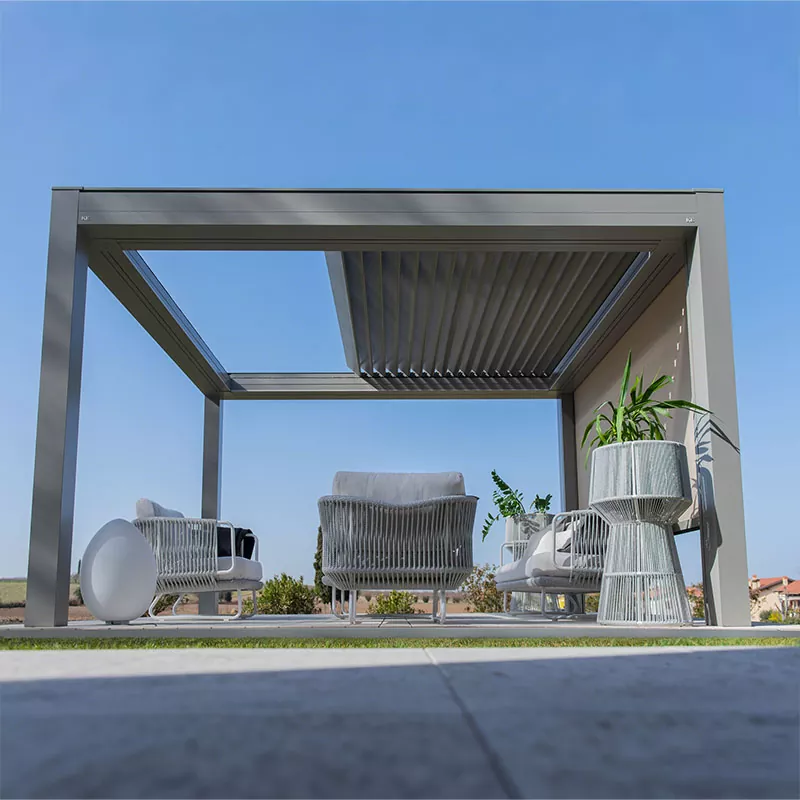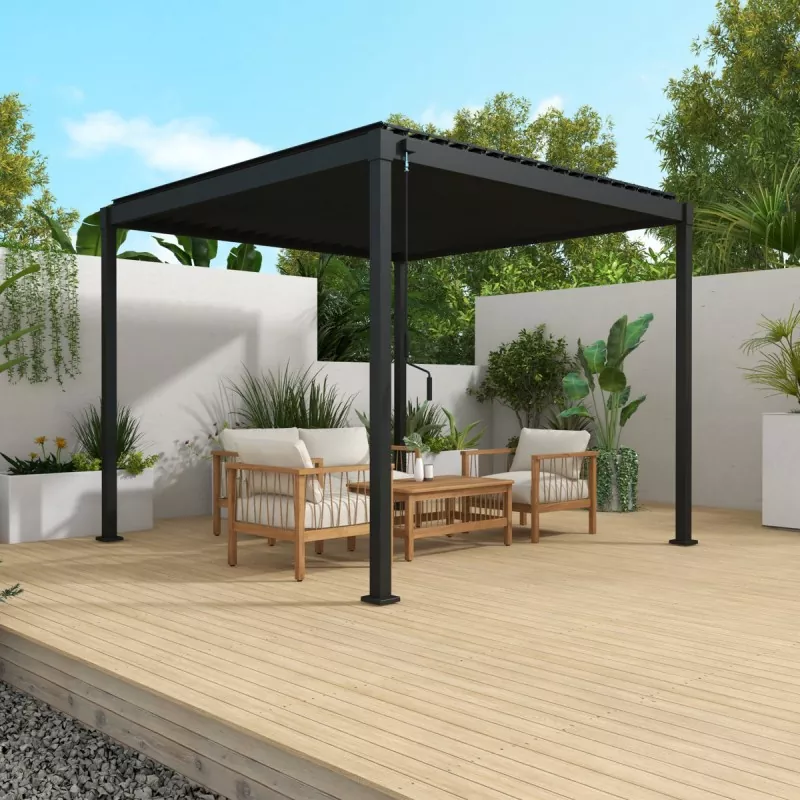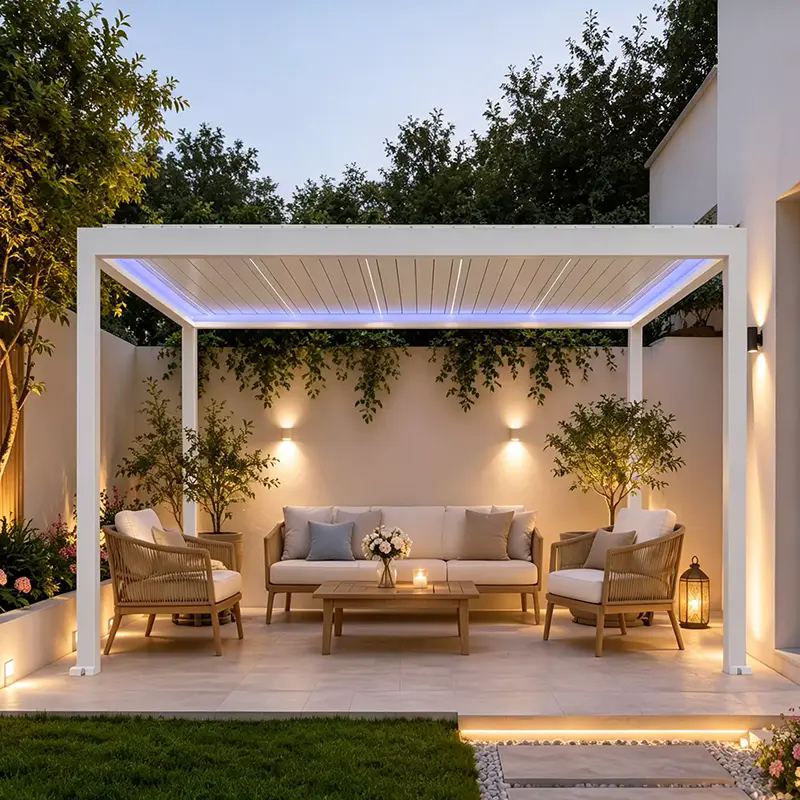
Do Louvered Pergolas Rattle in the Wind?
As outdoor living spaces transform into luxurious extensions of our homes, the demand for high-end architectural shading solutions has skyrocketed. Homeowners and commercial property managers alike frequently ask our team a critical question before investing: Do louvered pergolas rattle in the wind? It is a completely valid concern. No one wants to spend their relaxing weekend listening to the constant, irritating metallic clattering of a poorly constructed garden structure during a sudden gust of wind. At Vionta Metal, we believe that an outdoor living investment should bring absolute peace of mind and structural serenity to your backyard oasis.
The short answer is that cheap, low-grade kits bought from big-box retailers absolutely do rattle, squeak, and even fail under moderate wind loads. However, a premium, structurally engineered Aluminum Louvered Pergola will remain whisper-quiet even in the face of severe coastal gales. The difference lies entirely in the engineering choices, material thickness, precision tolerances, and hardware quality implemented during manufacturing. In this comprehensive guide, our factory experts will break down the exact physics of pergola noise, how advanced manufacturing eliminates structural vibration, and what specific technical parameters you must look for to ensure your outdoor sanctuary remains completely silent and safe.

Table of Contents
- Why Do Low-Quality Louvered Pergolas Rattle and Vibrate in Heavy Winds?
- How Our Factory Engineers Whisper-Quiet Wind Resistance into Every Aluminum Louvered Pergola
- What Technical Parameters and Structural Tolerances Prevent Pergola Noise?
- How to Choose an Aluminum Louvered Pergola That Withstands Coastal Winds?
- Frequently Asked Questions About Wind-Resistant Louvered Pergolas
- Conclusion: Invest in Lifetime Silence and Durability with Vionta Metal
Why Do Low-Quality Louvered Pergolas Rattle and Vibrate in Heavy Winds?
To understand why some outdoor structures make an unbearable racket during a storm, we must look at the basic principles of aerodynamics and mechanical tolerance. When wind hits an obstacle like a roof or a louver blade, it creates areas of high pressure on the windward side and low pressure on the leeward side. This pressure differential generates aerodynamic lift and drag forces. If the components of the structure are not perfectly secured or are made from thin, flexible materials, these forces cause rapid, cyclical movements known as structural flutter or vibration.
In the context of backyard shade structures, noise is almost always a symptom of poor manufacturing standards and cheap materials. When you analyze a budget-tier Aluminum Louvered Pergola, you will immediately find several fatal design flaws that contribute to chronic rattling:
- Insufficient Aluminum Wall Thickness: Many economy imports utilize aluminum frames that are less than 1.5mm thick. When high winds hit these thin profiles, the metal itself bends and flexes, causing the entire frame to distort and transfer vibrations directly into the operating mechanisms.
- Excessive Gaps in Operating Mechanisms: The louvers of an adjustable roof must rotate smoothly on pivot pins. In mass-produced, low-cost kits, the tolerances between the pivot pin and the receiving hole are poorly controlled, often leaving gaps of 1mm or more. When wind passes through the roof, it shakes each individual blade within that gap, creating a collective, deafening rattle.
- Flimsy Manual Connecting Rods: Budget structures often rely on thin, loose aluminum strips to connect the louvers together. These rods lack the structural rigidity required to lock the blades tightly in place when they are closed, allowing aerodynamic forces to bounce the louvers against each other.
- Absence of Internal Cushioning Systems: Metal-on-metal contact is the primary source of high-pitched clattering. Cheap pergolas lack specialized rubber gaskets or dampening seals along the margins where the blades meet, meaning any minor movement results in direct, noisy aluminum collision.
- Weak Lightweight Base Anchors: If the foundation posts are thin and secured with sub-standard fasteners, the entire structure will sway at its base. This global structural sway magnifies the movement at the roof level, causing even perfectly aligned components to twist and rattle under stress.
At Vionta Metal, we have spent more than two decades studying these mechanical failures to ensure our custom architectural systems never suffer from these compromises. True wind resistance is not just about preventing a structure from blowing away; it is about ensuring absolute mechanical stability, rigidity, and acoustic silence under every imaginable weather condition.
---How Our Factory Engineers Whisper-Quiet Wind Resistance into Every Aluminum Louvered Pergola
Eliminating wind noise requires a meticulous approach to industrial design and manufacturing precision. When our factory sets out to fabricate a high-performance system, we treat it as an architectural feature capable of enduring hurricane-force conditions. Our engineering team controls every single stage of production, from raw aluminum billet extrusion to the final quality checking of the mechanized drive systems. Here is exactly how our production methodologies eliminate structural vibration at the source:
- Heavy-Gauge 6063-T5 Architectural Aluminum: We exclusively use premium, virgin 6063-T5 aluminum alloy across our entire product line. This specific temper provides exceptional tensile strength and structural rigidity. Our main support pillars and framework beams feature wall thicknesses ranging from 2.0mm to 3.5mm, ensuring a rock-solid, deflection-free skeleton that absorbs and dissipates wind energy without transferring it to the moving louvers.
- Double-Layer Hollow Core Louver Blades: Unlike single-sheet louvers that warp and twist under aerodynamic load, our factory designs heavy-duty, double-walled hollow louvers. The internal reinforcing web within each blade drastically increases its torsional resistance, preventing the center of long-span louvers from bowing or vibrating when hit by powerful updrafts.
- Integrated Dual-Layer EPDM Rubber Gasketing: To completely eliminate metal-on-metal clattering, we integrate heavy-duty, UV-stabilized EPDM rubber gaskets along the entire length of every single louver blade interlocking edge. When our system is fully closed, these gaskets compress to form a continuous, soft-cushioned barrier. This not only provides an absolute acoustic dampening system that prevents rattling but also ensures a 100% watertight roof seal.
- CNC-Machined High-Precision Internal Connections: We avoid loose manual linkages by engineering a robust internal drive mechanism utilizing heavy-duty stainless steel components. Every single pivot pin and connecting arm is machined to a strict tolerance of less than 0.05mm, eliminating the physical clearance space required for components to rattle against one another.
- High-Torque Somfy Motorized Drive Systems: A critical factor in stopping louver movement is maintaining consistent, heavy downward pressure when the roof is closed. Our motorized units utilize premium, automated internal locking drives that hold the louvers under active tension, preventing strong winds from lifting or shifting the blades even during sudden coastal pressure drops.
By focusing heavily on structural mass and microscopic mechanical tolerances, Vionta Metal delivers premium systems that outperform standard commercial offerings. We understand that your comfort depends on quiet operation, which is why our factory subjects every design to strict stress and acoustic testing before it ever leaves our loading docks.
---What Technical Parameters and Structural Tolerances Prevent Pergola Noise?
When assessing an outdoor structure for long-term durability and silent operation, you must move past basic aesthetics and inspect the cold, hard engineering metrics. Relying on vague product descriptions is a recipe for disaster in high-wind environments. Buyers must look directly at quantified engineering certifications, wind load ratings, alloy compositions, and wall thicknesses to ensure they are purchasing a structurally sound architectural product.
To make it easy to evaluate your next outdoor project, we have compiled the essential engineering parameters that separate a standard residential kit from a professional-grade, whisper-quiet system. The data below outlines the baseline specifications we enforce at Vionta Metal to guarantee maximum stability and silence:
| Structural Component | Standard Economy Market Spec | Vionta Metal Heavy-Duty Premium Spec | Acoustic & Structural Impact |
| Aluminum Profile Alloy | Recycled or low-grade 6061 aluminum | Virgin, high-tensile 6063-T5 Aluminum | Maximizes structural rigidity; eliminates metal fatigue and twisting under cyclic wind loads. |
| Post/Pillar Wall Thickness | 1.2mm — 1.5mm thin profiles | 2.0mm — 3.5mm ultra-heavy profiles | Prevents global frame deflection and swaying, which is the primary cause of upper roof noise. |
| Louver Blade Architecture | Single-layer flat or curved sheet | Double-wall hollow core with internal rib | Eliminates aerodynamic flutter and bending across wide spans during high-velocity wind storms. |
| Wind Resistance Certification | Unrated or tested up to 60 km/h | Certified up to 120-150 km/h (Class 11) | Guarantees structural survival and absolute operational silence during severe coastal gales. |
| Mechanical Machining Tolerance | 1.0mm — 2.0mm loose clearance | Less than 0.05mm ultra-precise clearance | Removes the physical micro-gaps between pins and louvers, completely stopping physical rattling. |
| Joint Sealing & Cushioning | None; raw aluminum-on-aluminum contact | Co-extruded dual-lip EPDM rubber gaskets | Absorbs all mechanical kinetic energy, providing total silence and an airtight, watertight seal. |
| Hardware & Fasteners | Standard galvanized or carbon steel screws | Marine-grade 304 or 316 Stainless Steel | Prevents rust-induced loosening over time, ensuring connections remain tight and noise-free for decades. |
By choosing a system built around these advanced specifications, you ensure that your outdoor living environment remains structural, stable, and completely quiet. Our factory engineers refuse to cut corners on these dimensions because we know that structural mass and premium tolerances are the only true defense against the destructive and noisy nature of wind forces.
---How to Choose an Aluminum Louvered Pergola That Withstands Coastal Winds?
If you live in a coastal area, a high-altitude zone, or an open plain prone to severe weather, selecting the right outdoor structure requires careful evaluation. You cannot simply look at a photo online and determine if the system will function quietly when a storm rolls through. You need an organized checklist to guide your purchasing decision, ensuring that every dollar spent goes toward genuine structural engineering and acoustic peace of mind.
Here is the exact step-by-step evaluation process our seasoned project managers recommend when sourcing a premium, wind-resistant solution for your home or commercial venue:
- Request Verified Wind Load Test Reports: Always ask the manufacturer for official laboratory wind tunnel test certifications. A reputable factory will provide comprehensive documentation showing exactly how the structure performs at different wind velocities. If a supplier cannot provide real engineering data showing a wind rating of at least 100 km/h, the product is likely a lightweight decorative piece rather than a true architectural structure.
- Examine the Physical Louver Cross-Section: Request a physical sample or a detailed technical CAD drawing of the louver blade. Look specifically for a double-walled hollow profile with internal vertical or diagonal reinforcing struts. If the blade looks like a simple single-layer piece of sheet metal, avoid it at all costs, as it will inevitably warp, vibrate, and rattle under moderate wind loads.
- Check for Comprehensive Gasket Integration: Inspect the sealing system of the louvers. You want to see continuous, heavy-duty rubber or silicone gaskets embedded into specialized tracks along every single blade edge and gutter line. Avoid any system that relies on bare metal faces closing directly against other bare metal faces, as this configuration guarantees loud, metallic clanging in turbulent air.
- Evaluate the Internal Drive and Connection Hardware: Ask how the louvers are moved and held in position. Look for internal, concealed drive mechanisms made from thick stainless steel or heavy aluminum tracking. Cheap external plastic linkages or thin exposed rods degrade quickly in the sun, loosen up within months, and allow the louvers to shake freely whenever the wind picks up.
- Assess the Footing and Base Plate Design: A quiet roof requires an immovable base. Check that the pillars feature thick, heavy-duty internal or external steel base plates that can be anchored deeply into concrete footings with heavy expansion bolts. Lightweight aluminum plates or simple decorative slip-on shoes will allow the frame to twist, accelerating wear and creating systemic structural noise.
- Verify Custom Manufacturing Capabilities: Mass-produced fixed-size kits are rarely optimized for specific wind zones. Working directly with an experienced manufacturer like Vionta Metal allows you to customize the structural engineering—such as increasing pillar wall thickness or adding internal structural reinforcements—to precisely match the wind conditions and building codes of your exact geographical location.
Frequently Asked Questions About Wind-Resistant Louvered Pergolas
What features should I look for in an Aluminum Louvered Pergola to ensure it stays completely quiet during major wind storms?
To ensure absolute silence during major wind storms, you must look for a system engineered with heavy-gauge 6063-T5 aluminum profiles featuring a minimum wall thickness of 2.0mm to 3.5mm, paired with double-walled hollow-core louver blades that prevent aerodynamic flexing. Additionally, the system must incorporate integrated, high-density EPDM rubber gaskets along all interlocking blade edges to absorb kinetic energy and completely eliminate metal-on-metal contact, alongside precision-machined internal stainless steel drive linkages with tolerances under 0.05mm to eliminate loose physical play.
---Why should I invest in a premium Aluminum Louvered Pergola rather than choosing a cheaper wood or vinyl alternative for high-wind areas?
Investing in a premium engineered aluminum system over wood or vinyl is essential because aluminum offers a vastly superior strength-to-weight ratio, completely resists rot, warping, cracking, and twisting caused by weather exposure, and allows for micro-precision machining of adjustable louvers that remain structurally stable without loosening over time. Wood inevitably checks, warps, and loosens around fasteners as it ages, while vinyl lacks the structural rigidity to handle high wind pressures, leading to severe component distortion, chronic rattling, and total mechanical failure under heavy wind loads.
---How should I position the roof of my Aluminum Louvered Pergola when severe hurricane-force winds are expected?
When severe hurricane-force winds are expected, you should open the louver blades to a vertical position (roughly 60 to 90 degrees) to allow high-velocity air streams to pass completely free and unobstructed through the structure, which drastically reduces the aerodynamic lift and drag forces acting upon the framework. Closed louvers act like a solid sail, generating massive upward or downward structural pressures that put extreme stress on the anchor bolts, columns, and mechanical components, meaning that keeping the louvers open is the safest way to equalize pressure and protect the entire installation from damage.
---What maintenance steps are required to keep an Aluminum Louvered Pergola operating quietly and preventing any rattles over decades of use?
Maintaining a quiet, rattle-free operation over decades requires an easy biannual inspection schedule consisting of clearing leaves and debris out of the internal drainage gutters to prevent blockages, spraying the stainless steel pivot pins and moving joints with a high-quality dry silicone lubricant to maintain smooth movement, and checking the EPDM rubber gaskets for any signs of debris accumulation or wear. You should also verify that all base anchoring bolts and structural bracket fasteners remain torqued down tightly, ensuring that the entire structural framework stays rigid and completely vibration-free through every changing season.
---Why does an engineered Aluminum Louvered Pergola provide a vastly superior ROI for commercial venues compared to standard residential shade kits?
An engineered commercial-grade system provides an exceptional return on investment because its robust wind resistance allows restaurants, hotels, and country clubs to keep their outdoor seating spaces safely open and functional during unpredictable, gusty weather, completely eliminating lost revenue from canceled reservations. Furthermore, the extreme durability of heavy-duty aluminum and marine-grade components eliminates the frequent repair, alignment, and part replacement costs associated with cheap residential kits, providing a premium, whisper-quiet guest experience that enhances the value of the property for decades.
---Conclusion: Invest in Lifetime Silence and Durability with Vionta Metal
When evaluating whether a louvered roof will rattle in the wind, the ultimate deciding factor is the standard of manufacturing and engineering excellence behind the product. Cheap, uncertified kits will always succumb to the laws of aerodynamics, resulting in loose connections, bent frames, and an incredibly loud, irritating clattering sound whenever weather patterns shift. Investing in a premium, precision-engineered system from a dedicated manufacturer is the only definitive way to secure an outdoor living asset that remains perfectly tranquil, safe, and whisper-quiet throughout its lifetime.
At Vionta Metal, our factory leverages over two decades of metallurgical expertise and advanced CNC industrial manufacturing to build heavy-duty, architecturally certified outdoor systems tailored to your exact environment. Our heavy-gauge 6063-T5 aluminum profiles, double-wall hollow louver configurations, and co-extruded EPDM rubber seals ensure that our structures stand completely motionless and silent under the toughest coastal conditions. Do not compromise on the tranquility of your architectural investments. Contact our specialist engineering team today to receive a comprehensive technical consultation, custom CAD blueprints, and an itemized factory-direct quote for your custom project, and let us help you create an extraordinary, high-performance outdoor sanctuary built to last a lifetime.
Related News
- Why Stainless Cable Railing Shines in Winter?
- How Can a Snow Load Aluminum Pergola Deliver Reliable Year-Round Outdoor Protection
- What Awning Fabric and Frame Options Are Available?
- Is Glass Railing Safe for Balconies and Terraces?
- What Makes Stainless Steel the Ideal Material for Outdoor Railings?
- Are Jalousie Windows Easy to Break Into?
Leave me a message