Ultimate Guide to Cable Railing Spacing Code and Safety Standards
Welcome to the definitive industry resource for modern railing solutions. As a veteran in the architectural hardware space with two decades of experience, I have seen design trends come and go, but the demand for clean lines and unobstructed views remains constant. However, the most beautiful railing is a failure if it does not meet the rigorous safety standards required by local and international building codes. At Vionta Metal, our mission is to marry high-end aesthetics with uncompromising structural integrity. In this guide, we will deep-dive into the technical specifications of cable railing spacing, helping you navigate the complexities of the 4-inch sphere rule, tension requirements, and post-spacing logic to ensure your project is both stunning and compliant.

Table of Contents
- What are the essential cable railing spacing codes you must follow?
- How do our factory specifications ensure maximum safety and durability?
- Why is cable tension and post deflection critical for inspection success?
- How can you install cable railing to meet residential and commercial standards?
- Common Questions Regarding Code and Safety
What are the essential cable railing spacing codes you must follow?
When we discuss cable railing safety, the conversation begins and ends with the International Residential Code (IRC) and the International Building Code (IBC). These regulations are designed to prevent accidents, particularly involving small children. At Vionta Metal, our engineering team prioritizes these codes in every component we manufacture. The core objective is to ensure that the horizontal or vertical infill is secure enough that it does not create a hazard.
The Universal 4-Inch Sphere Rule
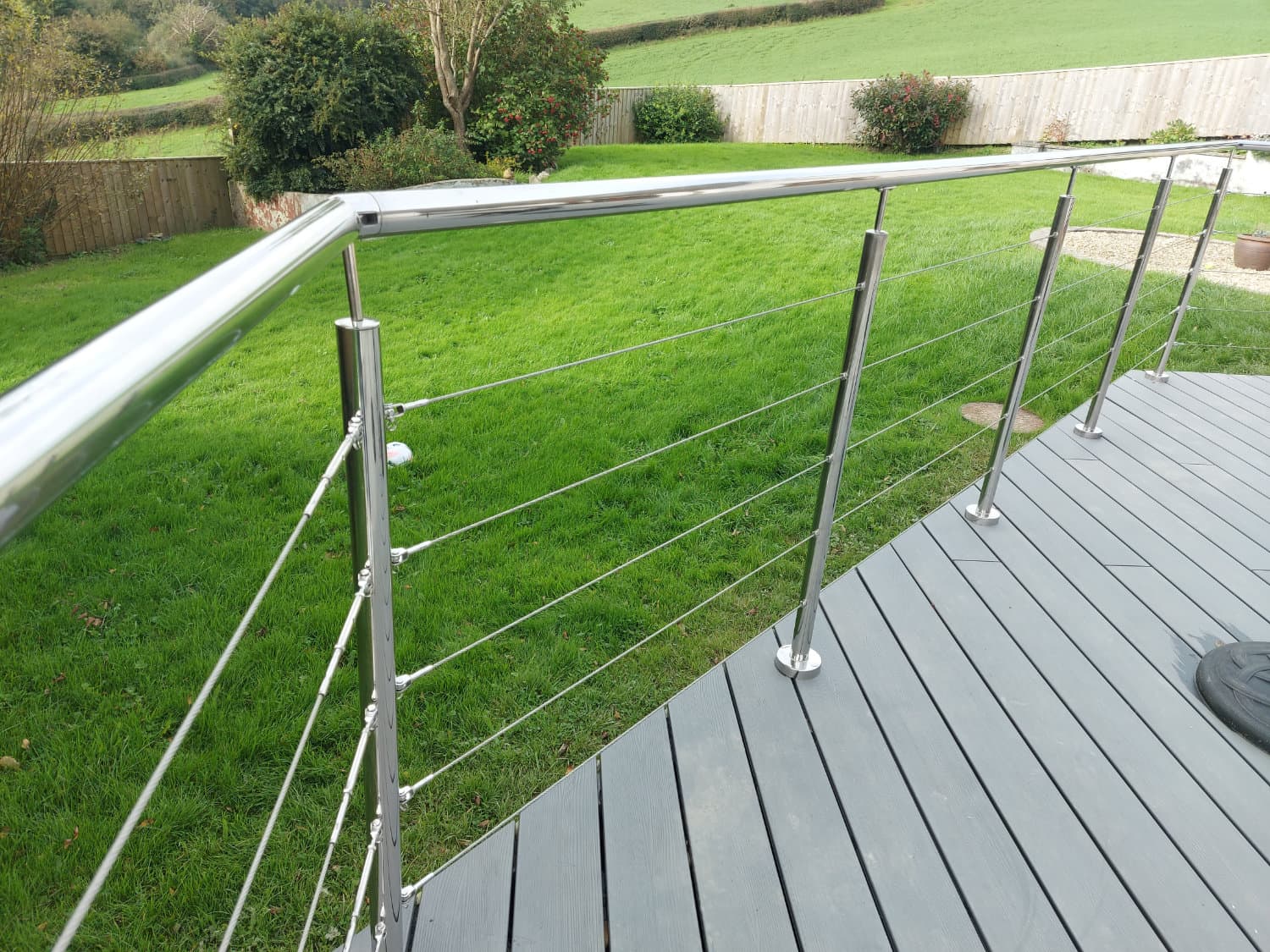
The most cited regulation in the industry is the 4-inch sphere rule. This code dictates that the spacing between infill elements (in this case, our cables) must be tight enough that a 4-inch diameter sphere cannot pass through at any point. This is based on the average size of a toddler’s head. While it sounds simple, achieving this with flexible cable requires more than just 4-inch intervals. Our factory recommends a 3-inch spacing between cables to account for "cable deflection." If you space the cables exactly at 4 inches, the natural flexibility of the wire might allow a 4-inch sphere to be pushed through under pressure, resulting in a failed inspection.
The Ladder Effect Debate
Historically, some jurisdictions restricted horizontal cable guardrail systems due to the "ladder effect," fearing children would climb the horizontal wires. However, most modern codes, including the most recent updates to the IRC, have removed this restriction for residential builds. Our Vionta Metal experts always advise checking with your local Authority Having Jurisdiction (AHJ) because local amendments can sometimes be stricter than national codes. Our products are designed to meet the highest safety thresholds to provide peace of mind regardless of your location.
Height Requirements and Structural Loads
The height of the railing is just as important as the spacing. In most residential applications, the top rail must be at least 36 inches high. For commercial applications, this often increases to 42 inches. Furthermore, the railing must be able to withstand a concentrated load of 200 pounds applied in any direction at the top of the rail. We ensure our posts and mounting hardware are engineered to handle these significant forces without deformation.
How do our factory specifications ensure maximum safety and durability?
At Vionta Metal, we don't just sell components; we provide engineered systems. Our factory utilizes Grade 316 Stainless Steel for all our cable railing products, ensuring they survive the harshest environments while maintaining their structural code compliance. To help you plan your project, we have outlined our standard product parameters that align with global safety standards.
Core Product Specifications
Our commitment to quality means using the right materials for the right job. Below is a breakdown of how our factory approaches the construction of cable guardrail components.
| Component | Specification Detail | Code Compliance Benefit |
| Cable Diameter | 1/8 inch or 3/16 inch (1x19 strand) | High tensile strength with minimal stretch. |
| Material Grade | T316 Marine Grade Stainless Steel | Superior corrosion resistance for long-term safety. |
| Vertical Post Spacing | Recommended 3 feet to 4 feet maximum | Minimizes cable deflection to meet the 4-inch rule. |
| Cable Spacing | 3 inches on-center | Passes the 4-inch sphere test even under tension. |
| Tensioning System | Internal Swageless or Threaded Terminals | Allows for precise adjustment to reach 200lb-400lb tension. |
| Mounting Type | Top Mount or Side (Fascia) Mount | Engineered to meet the 200lb concentrated load test. |
Why Choose Our 1x19 Strand Construction?
The type of cable you use significantly impacts safety. Our factory specializes in 1x19 strand stainless steel cable. Unlike 7x7 or 7x19 cables, which are more flexible and prone to stretching (used mostly for pulleys), 1x19 is stiff, smooth to the touch, and has very low stretch. This stiffness is vital for maintaining the "spacing code" over many years. When you use our 1x19 cable railing, you are choosing a product that stays taut and requires significantly less maintenance over its lifespan.

Post Design and Structural Integrity
Spacing code isn't just about the wires; it’s about the posts that hold them. If your posts are spaced too far apart, the cable will sag. If the posts aren't strong enough, the tension of the cables will pull them inward. We recommend that our customers never exceed a 4-foot span between structural posts. In our Vionta Metal design kits, we offer intermediate "picket" posts which are thinner and designed solely to maintain cable spacing without the bulk of a full structural post. This maintains the "open view" while ensuring the 4-inch sphere cannot pass through.

Why is cable tension and post deflection critical for inspection success?
One of the biggest hurdles during a building inspection is cable deflection. Deflection is the amount a cable moves when force is applied to it. Even if your cables are spaced 3 inches apart, if they are loose, an inspector can easily pull them apart to exceed the 4-inch limit. At our factory, we have tested various tension levels to provide our clients with the best results.
Understanding Tension Requirements
To pass a strict inspection, each cable typically needs to be tensioned to between 200 and 400 pounds. This creates a cumulative force on your end posts that can be immense. For example, a 10-cable run at 300 pounds of tension per cable exerts 3,000 pounds of pull on your end posts. This is why Vionta Metal emphasizes the use of strong top rails and robust end posts. Without a proper top rail to act as a compression member, the end posts will eventually lean inward, causing the cables to sag and fail the spacing code.
Key Factors Influencing Deflection
- Post Spacing: The further apart your posts are, the more the cable will deflect when pushed. Keeping posts at 3 to 4 feet is the industry gold standard.
- Cable Diameter: A 3/16-inch cable will naturally deflect less than a 1/8-inch cable under the same amount of tension.
- Number of Cables: Standard 36-inch residential railings usually require 10 to 11 runs of cable to ensure the gap between the floor and the first cable, and between the cables themselves, never exceeds the code limit.
- Tensioning Sequence: We always recommend tensioning from the middle cables outward to the top and bottom to distribute the load evenly across the post.
The Role of the Top Rail
Many homeowners ask if they can skip the top rail for a "cleaner" look. From a code perspective, this is very difficult to achieve. The top rail is a structural component that resists the inward pull of the cables. At Vionta Metal, we provide specialized top rail connectors that integrate seamlessly with our cable guardrail systems, ensuring the entire structure remains rigid and the cable spacing remains permanent.
How can you install cable railing to meet residential and commercial standards?
Installation is where the theory of "code" meets the reality of construction. Whether you are a DIY enthusiast or a professional contractor, following a standardized process is essential for safety. Our team has refined the installation workflow to ensure our cable railing systems are installed correctly every time.
Step-by-Step Compliance Checklist
- Layout Planning: Mark your post holes precisely. Ensure that the distance from the floor to the first cable hole is no more than 3 inches.
- Drilling Accuracy: Use a drill guide to ensure holes are perfectly level. Misaligned holes create friction, making it harder to tension the cables properly.
- Installing End Posts: Securely bolt your end posts. These are the anchors of your system and must be able to withstand the tension load mentioned earlier.
- Running the Cable: Thread our Vionta Metal 1x19 cable through the intermediate posts. Use protective sleeves if you are passing through wood posts to prevent the cable from biting into the wood.
- Tensioning: Use a tension meter to verify that each run meets the required specifications. This is the best way to prove to an inspector that the system is safe.
- Final Trim: Once tensioned, trim the excess cable and apply end caps for a professional, snag-free finish.
Commercial vs. Residential Considerations
If your project is a public space or a multi-family dwelling, the IBC standards apply. These are often stricter than residential codes. For instance, the 4-inch sphere rule remains, but the load requirements for the handrail might be higher, and there are specific requirements for "graspability" if the railing is on a stairway. Our factory produces heavy-duty components specifically designed for these high-traffic commercial environments, ensuring our cable guardrail solutions are as durable as they are beautiful.
Common Questions Regarding Code and Safety
Is cable railing safe for homes with small children and pets?
Yes, when installed to the 4-inch sphere code with proper tensioning, cable railing is extremely safe as it provides no large gaps and is difficult for children to climb due to the lack of a solid foothold.
How often do I need to re-tension the cables to stay within code?
With our high-quality 1x19 stainless steel cables, you should only need to check tension once a year, though usually, very little adjustment is required after the initial "settling" period following installation.
What is the maximum distance allowed between two railing posts?
To ensure the cables do not deflect beyond the 4-inch limit, we recommend a maximum distance of 4 feet between structural posts, or the use of spacing pickets every 3 feet.
Can I use 1/8 inch cable for a commercial project?
While 1/8 inch is often sufficient for residential use, many commercial inspectors prefer 3/16 inch cable due to its higher breaking strength and lower deflection rate under public use conditions.
Do I need a bottom rail for cable railing to be code-compliant?
A bottom rail is not strictly required by international code as long as the bottom cable is close enough to the deck surface (usually within 3 inches) that the 4-inch sphere cannot pass underneath it.
Conclusion: Building for the Future with Vionta Metal
Adhering to cable railing spacing code is not just about passing an inspection; it is about protecting the people who use the space. By understanding the relationship between post spacing, cable tension, and the 4-inch sphere rule, you can create a safe environment without sacrificing the modern aesthetic you desire. At Vionta Metal, our factory is dedicated to producing the highest quality cable guardrail components that empower you to build with confidence. From our marine-grade stainless steel to our precision-engineered tensioners, every part of our system is designed to meet the rigorous demands of modern building codes.
Are you ready to elevate your property with a safe, stylish, and code-compliant railing system? Contact our expert team today for a custom quote or technical consultation. Let Vionta Metal help you turn your vision into a reality that stands the test of time. Reach out now to explore our full range of products and see how our expertise can streamline your next project!
Related News
- Are Jalousie Windows Easy to Break Into?
- Is Stainless Steel Glass Railing Safe?
- How waterproof is an aluminum louvered pergola during heavy rain, and how should its drainage capacity be tested?
- How Strong Is Aluminum Railing Compared With Steel Railing?
- How to Choose Metal Railing for Residential and Commercial Projects
- How To Remove Hard Water Stains From Glass Railings?
Leave me a message