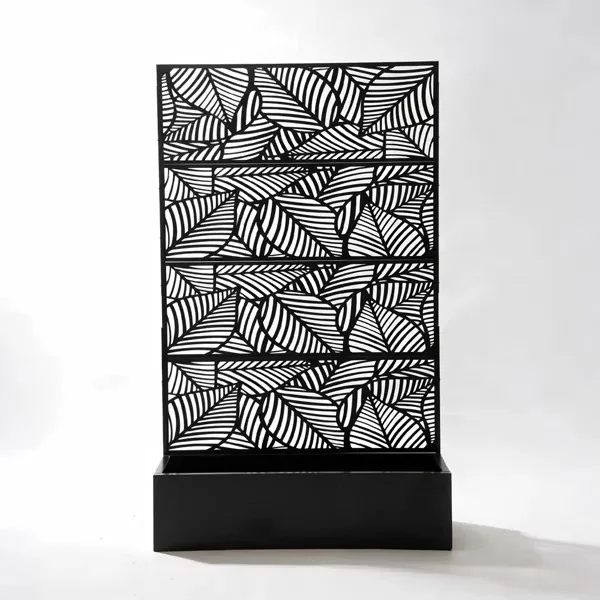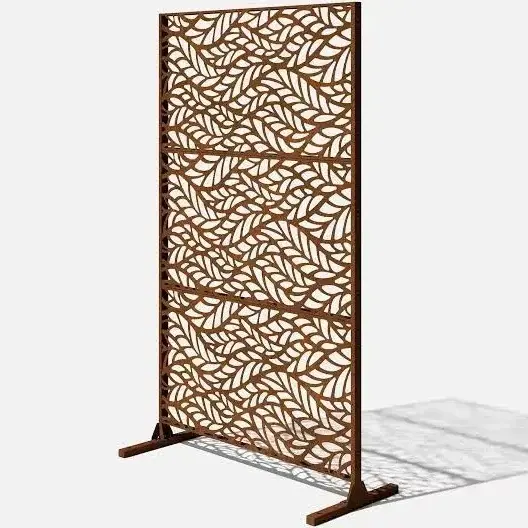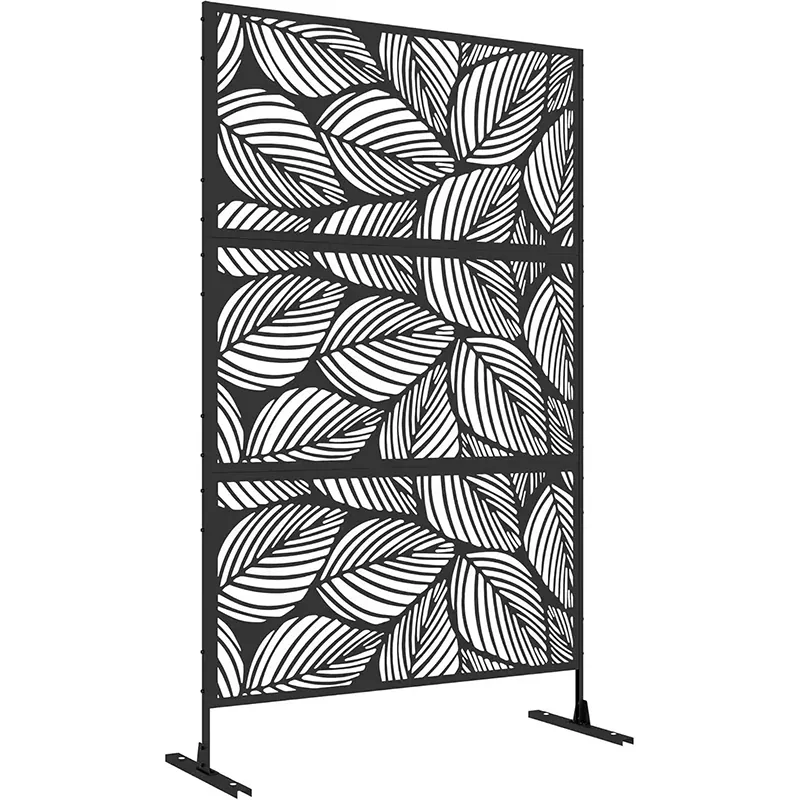


Metal Privacy Screen
As a decorative metal laser cut privacy screens manufacturer, Vionta Metal offers superior quality and affordable metal privacy screens. Our panels are the perfect solution for a variety of usage scenarios, such as hiding your neighbor’s backyard, blocking direct sunlight, creating privacy, or enhancing your outdoor space.
Specifying a metal privacy screen for a real project takes more than choosing a pattern. Material thickness, panel sizing, wind load, and the anchoring method are what determine whether an installation holds for one season or twenty years. This page covers that engineering side: material specifications, standard panel sizes, wind resistance, and step-by-step anchoring methods for four common site conditions.
Looking for pattern options or a finished-look reference instead? See our Decorative Privacy Screen catalog for laser-cut design choices, or Outdoor Privacy Screen for our full corrosion-protection and coating process.

Vionta Metal manufactures these panels in aluminum, galvanized steel, and stainless steel, cut on high-precision fiber laser equipment and finished with a powder coating rated for UV and salt-spray exposure. Panels are sold as wall-mounted, floor-mounted-with-posts, or freestanding units, and are used for residential boundary screening, entrance gates, commercial frontages, and landscape architecture projects.

Product Specifications
As a China-based metal products factory, Vionta Metal works to the standard specifications below for most export orders, with customizable modules available on request.
| Specification | Details | Notes / Options |
|---|---|---|
| Material | Aluminum, Galvanized Steel, Stainless Steel | Optional powder coating or customized finish |
| Panel Thickness | 1.5 mm–5 mm | Depends on size and wind load requirements |
| Panel Size (Standard) | 1000×2000 mm / 1200×2000 mm / 1500×2000 mm | Custom sizes available |
| Weight | 10–25 kg per panel (varies with material & thickness) | Lightweight aluminum easier to handle |
| Surface Finish | Powder-coated, Electrostatic coating | Outdoor-grade, UV & rust resistant |
| Pattern Type | Laser-cut decorative patterns | Custom patterns supported (CAD drawings accepted) |
| Mounting Type | Wall-mounted, Floor-mounted with posts, Freestanding | Hardware included; posts optional for freestanding |
| Color Options | RAL colors or custom | Common: Black, White, Grey, Bronze |
| Wind Resistance | Up to 120 km/h (depending on panel thickness & mounting) | Recommend additional posts for large panels |
| Installation Accessories | Screws, brackets, fixing accessories | Stainless steel or galvanized |
| Usage | Residential, Commercial, Outdoor spaces | Gardens, patios, balconies, poolside, entrance gates |
| Custom Options | Size, Pattern, Color, Material, Mounting | OEM/ODM supported |
How to Anchor Metal Privacy Screens
The success of a metal privacy screen installation depends less on the screen itself than on the fixing method. We've worked on projects where the client assumed "the screen is fine," only to find out later that the wrong installation method had been used for the site conditions. Below are the fixing methods we recommend for each common base, and when to use each one.
Confirm the Installation Base First
Before installation, the first question is: where will the privacy screen actually be fixed? There are four common bases:
- Concrete or stone ground
- Soil / grass
- Wooden deck or patio
- Wall or façade structure
Each base requires a different fixing method. Using the wrong one results in wobbling, tilting, or the screen falling over.
1. Fixing to Concrete or Stone Ground (Most Secure)
This is the most common and most recommended method, suitable for courtyards, patios, poolside areas, and commercial projects.
Standard procedure:
- The screen has a base plate or posts at the bottom
- Drill holes in the concrete
- Use expansion bolts or concrete anchors for fixing
- Level the screen, then fully tighten the bolts
This method gives high stability, strong wind resistance, and minimal maintenance. Level the screen before tightening the bolts — once it's fixed to concrete, there's almost no room for adjustment afterward.
2. Fixing to Soil or Grass (Requires a Concrete Base)
For gardens, lawns, or other soft ground, simply inserting the screen into the ground is not advisable. The correct approach:
- Pre-bury metal posts
- Pour concrete around the base of the posts
- Install the privacy screen only after the concrete has fully cured
This ensures the weight and wind force are carried by the concrete, not the soil.
3. Fixing to Wooden Decks or Patios (Focus on the Structure)
Wooden decks can look sturdy but are actually the most prone to problems. The key principle: fixing must reach the joists or load-bearing structure, not just the surface planking.
Common methods:
- Bolting through the wooden panel into the structural beam below
- Adding a metal base plate or reinforcement where needed
Fixing only to the surface of the wooden panel may hold in the short term, but wobbling over time is unavoidable.
4. Securing to a Wall (Clean Look, Watch the Load-Bearing Capacity)
Wall-mounting is common on balconies, terraces, or decorative applications, and gives a cleaner overall look.
- The wall must be load-bearing, or a solid concrete/brick wall
- Use metal brackets and expansion bolts for fixing
- Not recommended on purely decorative or lightweight walls
This method saves floor space but requires stronger wall conditions.
Wind Load (Often Overlooked)
A metal privacy screen is essentially a panel standing outdoors, so wind is always a factor to plan for:
- For tall or large screens, add support columns
- Hollowed-out laser-cut patterns help reduce wind resistance
- Use thicker material for coastal or windy areas
Confirming these conditions at the start of a project saves a lot of trouble later.
Frequently Asked Questions
Can a metal privacy screen be installed directly on a wooden deck?
No. It must be bolted through the deck boards into the structural joists or beams below, not just the surface planking. Fixing to the surface boards only typically leads to wobbling within one to two seasons.
Do tall or wide privacy screen panels need extra support?
Yes. For taller or larger panels, adding support columns is recommended, along with thicker material in coastal or high-wind regions.
Can a metal privacy screen be installed directly in soil or a lawn?
No. Soft ground requires pre-buried posts set in a concrete footing so the weight and wind load are carried by the concrete rather than the soil.
Get a Free Quote
Looking for a reliable laser-cut metal privacy screen manufacturer for your next project? Contact Vionta Metal for custom designs, competitive pricing, and engineering support on anchoring and wind-load requirements for your specific site.
Send us your drawings or site conditions — our team will turn them into a precision-engineered metal privacy screen solution, ready to install.
Hot Tags: Metal Privacy Screen, Custom Metal Privacy Screen, Outdoor Privacy Screen Panels, Laser Cut Metal Screens, Privacy Screen Manufacturer, Privacy Screen Wholesale
Send Inquiry
Contact Info
-
Address
No. 26, Lane 293, Cilong East Road, Longshan Town, Cixi City, Ningbo City, Zhejiang Province, China
-
Tel
-
E-mail
For inquiries about Metal Railing, Aluminium Pergola, Aluminium Awning or price list, please leave your email to us and we will be in touch within 24 hours.