How Tall Should Deck Railing Be?
Vionta Metal
Premium Deck Railing Systems Since 2008
Complete Building Code Guide
How Tall Should Deck Railing Be?
Everything homeowners, contractors, and developers need to know about deck railing height requirements, code compliance, and choosing the right system.
Updated 2026 15 min read IRC Code Referenced By Vionta Metal Editorial Team
Table of Contents
- Why Does Deck Railing Height Even Matter?
- What Does the Building Code Actually Require for Deck Railing Height?
- How Does Required Railing Height Vary by Deck Elevation and Location?
- What Makes Aluminum Deck Railing the Best Choice for Code-Compliant Installations?
- How Do You Properly Measure and Install Deck Railing to the Correct Height?
- What Are the Full Specifications for Our Deck Railing Systems?
- Conclusion
- FAQ: Common Questions About Deck Railing
Why Does Deck Railing Height Even Matter?
Understanding the safety logic behind every inch of your guardrail
Walk onto any residential deck in America, Canada, or the UK, and you will quickly notice that the railing surrounding it almost always sits somewhere between 36 and 42 inches off the decking surface. That is not an aesthetic coincidence. That dimension reflects decades of injury data, engineering research, and hard-won regulatory experience that has shaped modern building codes into the life-safety framework they are today.
At Vionta Metal, we have supplied aluminum deck railing systems for thousands of projects across North America, and the single most common source of confusion during the planning phase is railing height. Homeowners assume any height looks fine. Contractors sometimes default to outdated code versions. Developers working across multiple states or provinces find themselves managing a patchwork of local amendments that differ from the base standard. The result is costly rework, failed inspections, and occasionally, tragic accidents.
The stakes are real. According to data from the Consumer Product Safety Commission, deck collapses and railing failures contribute to tens of thousands of emergency room visits annually in the United States alone. A significant proportion of those incidents involve guardrails that were either too short, incorrectly installed, or made from materials that degraded over time. Height is only one variable in the safety equation, but it is the most visible one, and the one your building inspector will check first.
36"
Minimum height for decks under 30 inches off grade
42"
Required height for decks 30 inches or more above grade
4"
Max baluster spacing to prevent child entrapment
200 lbs
Minimum lateral load capacity per IRC for deck railings
Why Height Is a Function of Fall Distance, Not Aesthetics
Building code writers did not pick 36 or 42 inches arbitrarily. Research into human biomechanics shows that a rail positioned at approximately 36 inches reaches roughly the hip-to-lower-chest zone of an average adult, which is the center of gravity region most relevant to preventing accidental toppling. At 42 inches, the rail rises to mid-torso or chest height for shorter adults, providing a much more substantial barrier against a stumbling fall.
When a deck sits close to grade, say 18 inches off the ground, a fall is unlikely to cause serious injury. The body has very little fall distance. But when a deck surface is elevated 8 feet above a concrete patio, the geometry of a fall changes dramatically. The extra 6 inches between a 36-inch and a 42-inch guardrail can be the difference between a near miss and a fatality. Code drafters account for this by tying the required height directly to the elevation of the deck surface above the ground below it.
This is why our team at Vionta Metal always asks clients about deck elevation before recommending a railing height. Installing a 36-inch system on a ground-level porch extension is perfectly legal in most jurisdictions. Installing that same system on a second-story deck would be a code violation that no amount of cosmetic appeal can justify.
What Happens When Deck Railing Height Is Wrong?
The consequences of incorrect railing height operate on multiple levels simultaneously, and understanding all of them helps explain why our aluminum deck railing systems are engineered to precise, documented dimensions from the factory.
- Failed inspection and stop-work orders: In most jurisdictions, a deck is not legally occupiable until it passes a final building inspection. Undersized guardrails trigger a mandatory correction, which means tearing out installed posts and re-setting them, often at significant cost and project delay.
- Voided homeowner insurance: Some insurance carriers specifically exclude coverage for injuries that occur on structures that did not pass code inspection. A deck with undersized railings that never received a permit can expose a homeowner to full personal liability in an injury lawsuit.
- Reduced property value and resale complications: Home inspectors routinely flag non-compliant deck railings during real estate transactions. Buyers may demand repairs as a condition of sale, or lenders may refuse to underwrite mortgages on properties with unpermitted structures.
- Personal injury liability: When a guest falls from a deck with a rail that does not meet code, the property owner bears the legal burden of demonstrating that reasonable care was exercised. Non-compliant height is difficult to defend in court.
- Aesthetic regret: Homeowners who install railing that is too short often find it looks and feels insubstantial. A properly proportioned 42-inch aluminum deck railing system frames an elevated deck the way a well-fitted frame completes a painting. The proportions simply look right.
At Vionta Metal, every aluminum deck railing section we manufacture ships with documentation that specifies the installed top rail height and confirms IRC compliance. That paperwork travels to the job site with the product, making the permitting and inspection process straightforward for both contractors and homeowners.
Who Is Responsible for Getting the Height Right?
Legally, the building permit applicant is responsible for code compliance. In a homeowner-built project, that is typically the homeowner. On a contractor-built project, the general contractor or the deck subcontractor carries the compliance burden, though the homeowner who signed the contract may share liability if they specifically directed a non-compliant installation.
In practice, the person installing the railing posts sets the height, and errors made at that stage are expensive to reverse. This is why professional deck contractors specify railing systems like those from Vionta Metal that arrive with factory-set top rail heights, clear installation templates, and code-cited documentation. It removes the guesswork from one of the most legally consequential dimensions on the entire project.
Our aluminum deck railing systems are engineered for contractor-friendly installation while delivering the structural performance that safety codes demand. Every component, from the post base plate to the top rail cap, is dimensioned to produce a finished installed height that meets or exceeds the applicable standard without requiring custom field fabrication.
What Does the Building Code Actually Require for Deck Railing Height?
Breaking down IRC, IBC, and Canadian NBC requirements in plain language
When most residential deck builders in the United States refer to "the code," they mean the International Residential Code, published by the International Code Council and adopted in some form by nearly every state and municipality in the country. Understanding what the IRC actually says about guardrail height, and equally important, where local amendments may diverge from that base standard, is essential knowledge for anyone building or buying a deck.
Canada operates under the National Building Code of Canada, which carries similar dimensional requirements but uses metric measurements. The UK and Australia each have their own standards. Our team at Vionta Metal regularly supplies aluminum deck railing systems to projects in all of these markets, and we maintain a current reference library of applicable standards to help our customers specify correctly.
The Core IRC Guardrail Requirements at a Glance
| Deck Height Above Grade | Minimum Guardrail Height Required | Applicable Code Section | Notes |
| Less than 30 inches (762 mm) | Guardrail not required by IRC | IRC R312.1.1 | Local jurisdictions may add requirements; always verify locally |
| 30 inches (762 mm) to less than 200 inches (5080 mm) | 36 inches (914 mm) minimum | IRC R312.1.1 | Most single-story decks fall in this category |
| 200 inches (5080 mm) or greater | 42 inches (1067 mm) minimum | IRC R312.1.1 | IBC commercial standard applies to occupied roofs, balconies over 30 inches at any height |
| Commercial and multi-family (IBC) | 42 inches minimum, all elevations over 30 inches | IBC Section 1015.3 | Applies to apartments, condos, hotels, commercial decks |
| Canada (NBC) low-rise residential | 1070 mm (approximately 42 inches) when surface is more than 600 mm above grade | NBC Article 9.8.8.1 | Metric standard; provincial codes may require more |
It is worth pausing on a few details in that table that frequently catch builders off guard. First, the IRC does not require any guardrail at all for a deck that sits less than 30 inches off the ground. However, that does not mean building one is a waste of money. Many homeowners install guardrails on low decks for aesthetic continuity, for safety comfort with small children, and because local jurisdictions frequently adopt amendments that require railings at lower thresholds than the base IRC standard.
Second, the jump from 36 inches to 42 inches is tied specifically to the 200-inch (approximately 16.6-foot) elevation threshold in the IRC itself, but the International Building Code, which governs commercial construction and multi-family housing, requires 42 inches for all guardrails at any elevation above 30 inches. If you are building a condominium balcony, a hotel terrace, or a mixed-use building deck, 42 inches is your starting point regardless of how high above grade the surface sits.
Where Local Code Amendments Most Often Diverge
The IRC is a model code. Individual states, counties, and municipalities adopt it by ordinance, and they frequently tack on amendments that are more restrictive than the base standard. Our customers regularly encounter the following local variations:
- California: The California Building Code largely mirrors IBC and requires 42-inch guardrails for all elevated walking surfaces in both residential and commercial applications, regardless of the IRC's 30-inch threshold.
- Florida: The Florida Building Code adopts a 42-inch requirement more broadly and has specific hurricane-resistance provisions that affect post anchorage and lateral load ratings for railing systems.
- New York City: New York City uses the NYC Building Code, which is significantly more stringent than both IRC and IBC on guardrail height, structural loading, and post spacing. Projects in the five boroughs require careful local code review.
- Texas: Texas has adopted the IRC with relatively few amendments for most jurisdictions, but home-rule cities like Houston and Austin may have their own specific requirements layered on top.
- British Columbia and Ontario: Both provinces require 1070 mm guardrails for residential decks elevated more than 600 mm above grade, but some municipalities have additional requirements for upper-story balconies.
Always verify locally before purchasing. Even the most accurately specified railing system will fail inspection if the jurisdiction has adopted an amendment that the base code does not reflect. Our team at Vionta Metal can assist with code lookups for common markets, but we always recommend confirming with your local building department before finalizing your specification.
Baluster Spacing Rules That Accompany Height Requirements
Guardrail height is only one dimension the code cares about. Equally important is the spacing between balusters, the vertical infill members that fill the space between posts under the top rail. The IRC requires that balusters be spaced so that a 4-inch-diameter sphere cannot pass through any opening in the railing system. This rule exists specifically to prevent young children from getting their heads trapped between balusters.
At the bottom of the railing, the code also requires that the gap between the bottom rail and the deck surface not exceed 4 inches. At the top, the open space between the top of the rail and the underside of the top rail must meet the 4-inch sphere rule as well. Our aluminum deck railing systems from Vionta Metal are designed with baluster spacing of 3.5 inches on center, which provides a comfortable margin under the 4-inch maximum and produces a visually balanced appearance with no open gaps that raise safety concerns.
How Does Required Railing Height Vary by Deck Elevation and Location?
A practical breakdown of the scenarios contractors and homeowners actually encounter
Understanding the abstract code requirements is one thing. Mapping those requirements onto the actual physical scenarios that arise during real deck construction is quite another. In our experience supplying deck railing systems across hundreds of different project types, the same code question gets asked in dozens of different contextual flavors. This section works through the most common real-world scenarios methodically.
Scenario Breakdown by Deck Type and Elevation
| Deck Type | Typical Height Above Grade | Required Rail Height (IRC Base) | Common System Recommendation | Notes |
| Ground-level patio deck | 6 to 18 inches | Not required; optional | 36-inch decorative aluminum system | Often installed for aesthetics and pool code compliance |
| Standard single-story deck | 18 to 48 inches | 36 inches minimum (if over 30 inches) | 36-inch or 42-inch aluminum deck railing | Many owners choose 42 inches proactively for resale and safety |
| Raised single-story deck | 48 to 96 inches | 36 inches minimum (IRC residential) | 42-inch aluminum deck railing with reinforced posts | Falls from this height are extremely dangerous; 42 inches strongly advised |
| Second-story deck or balcony | 96 to 180 inches | 36 inches (IRC); 42 inches (IBC commercial) | 42-inch heavy-duty aluminum system | Most local codes apply commercial standard at this height |
| Rooftop deck or terrace | 180 inches and above | 42 inches minimum under IBC | 42-inch commercial-grade aluminum railing with wind bracing | Wind load calculations required in most jurisdictions |
| Pool deck surround | Any elevation | Varies; pool barrier codes typically require 48-inch minimum barrier | 48-inch aluminum pool railing system | Pool barrier codes are separate from deck guardrail codes and are typically more stringent |
| Stair handrail (alongside stairs) | N/A (measured differently) | 34 to 38 inches above stair nosing | Continuous graspable aluminum handrail | Stair handrail height is measured from the leading edge of the stair tread, not from the landing |
| Commercial restaurant or bar deck | Any elevation over 30 inches | 42 inches minimum (IBC) | 42-inch architectural aluminum railing with glass or cable infill | ADA accessibility provisions also apply in commercial settings |
How Stair Handrail Height Differs from Guardrail Height
One of the most persistent sources of confusion among homeowners tackling a deck project is the distinction between a guardrail, which prevents falls over the edge of an elevated surface, and a stair handrail, which provides gripping support when ascending or descending a staircase. These two elements have different height requirements because they serve fundamentally different purposes and are measured from different reference points.
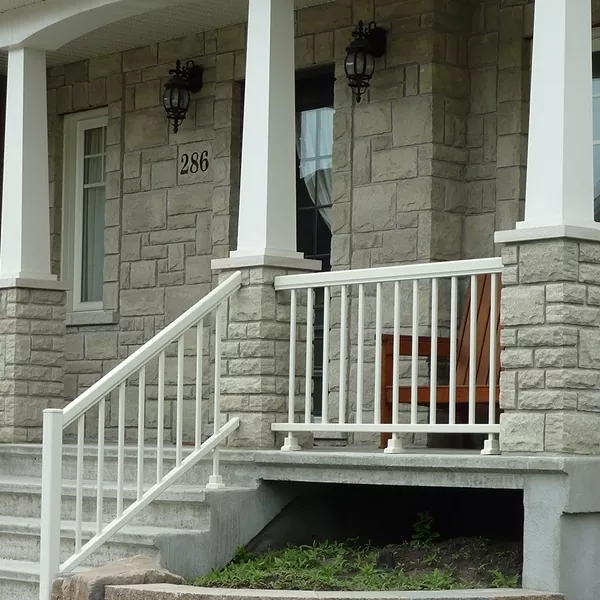
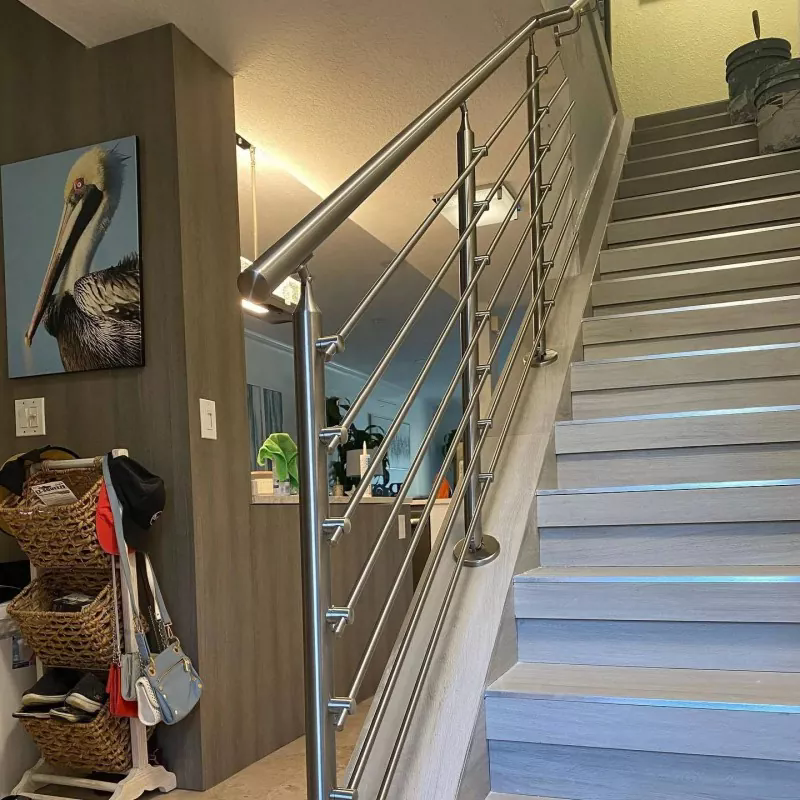
A guardrail height is measured vertically from the finished deck surface to the top of the rail. A stair handrail height is measured perpendicularly from the sloping stair nosing line to the top of the gripping surface. The IRC requires stair handrails to fall between 34 and 38 inches when measured this way. The handrail must also be continuously graspable for its entire length, which is why cable or panel infill systems used on the main deck often transition to a separate graspable top rail profile at the staircase.
- Guardrail height: measured vertically from the deck surface to the top of the rail at the post or mid-span location
- Stair handrail height: measured perpendicular from the sloped nosing line to the top of the gripping surface
- Both guardrail and handrail must be present on staircases with 4 or more risers (open side must have guardrail, top must have handrail)
- Graspability requirement: the handrail cross-section must allow a full hand grasp, typically circular 1.25 to 2 inches in diameter or equivalent
- Stair guardrail openings (in the guardrail alongside the stair) must pass the 4-inch sphere test just like deck guardrails
How Deck Railing Height Interacts with Aesthetic Design Decisions
Code compliance defines the floor, not the ceiling. You are entirely free to install a railing system that is taller than the code minimum, and in many design contexts, doing so produces a better visual result. Our aluminum deck railing collections at Vionta Metal include standard heights of 36 inches and 42 inches, with custom heights available on project orders. Here is how height choices play out in real design scenarios:
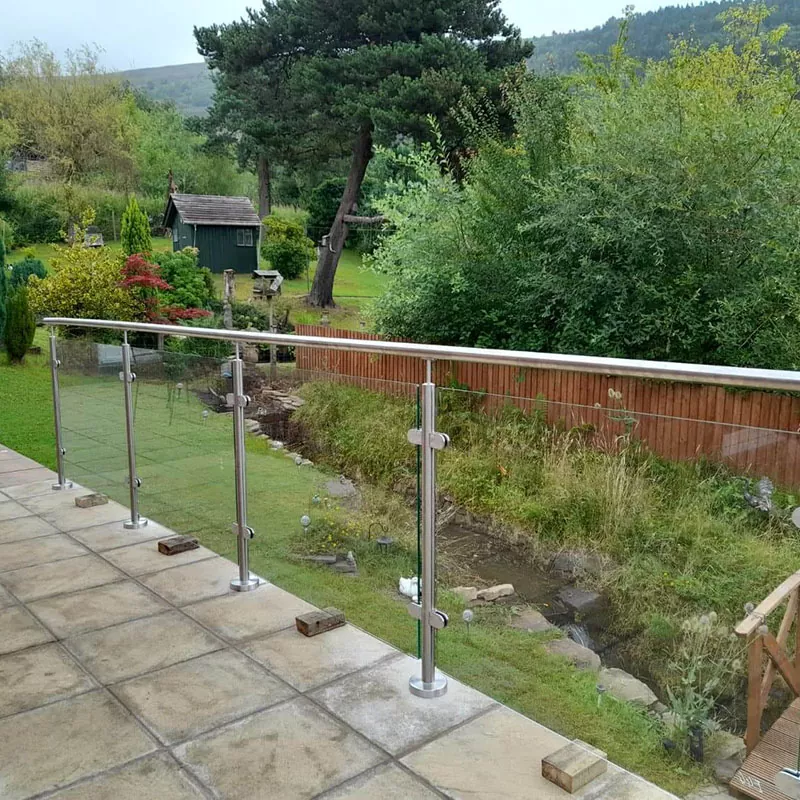
- Views and sightlines: On a deck overlooking a valley, lake, or garden, homeowners often prefer glass or cable infill systems at 42 inches rather than traditional balusters. The taller rail with transparent infill maintains safety while preserving the view. A 36-inch system with aluminum balusters on the same deck would meet code but create a more visually obstructed sightline.
- Privacy considerations: On an urban deck overlooking a neighboring property, some homeowners deliberately choose taller railing with solid panel infill to create a privacy screen effect. In this case, the railing height may exceed code minimums by a significant margin, functioning both as a safety guardrail and as architectural screening.
- Furniture ergonomics: A 42-inch railing is roughly the right height for a standing adult to lean against comfortably. If the deck is used primarily for standing social gatherings, a 42-inch rail feels more natural and hospitable than a 36-inch rail that catches people at thigh height.
- Child safety: Families with young children frequently opt for 42-inch railing on ground-level or slightly elevated decks where code does not technically require any railing at all. The peace of mind is worth far more than the additional cost.
What Makes Aluminum Deck Railing the Best Choice for Code-Compliant Installations?
A material comparison rooted in structural performance, longevity, and total cost of ownership
Every building material has strengths and weaknesses. The real question is not which material is best in the abstract, but which material best serves the specific demands of an exposed, structural, safety-critical component like a deck guardrail. Our aluminum deck railing systems have been our flagship product at Vionta Metal since our founding, and the reasons customers return to aluminum over other options are consistent, data-backed, and rooted in practical experience.
Corrosion Resistant Low Maintenance High Strength-to-Weight Code Compliant 25+ Year Lifespan Powder Coat Finish Recyclable Factory Pre-Cut
Material Comparison: Why Aluminum Wins on Structural Deck Railings
| Performance Factor | Aluminum | Pressure-Treated Wood | Vinyl / PVC | Wrought Iron / Steel |
| Corrosion resistance | Excellent; forms protective oxide layer naturally | Poor; requires chemical treatment and annual sealing | Excellent; fully impervious to moisture | Poor; steel rusts rapidly without coating maintenance |
| Structural strength at IRC load | Excellent; 6063-T5 alloy exceeds 200-lb lateral load | Good when new; degrades with moisture cycling | Fair; may flex under concentrated load without steel insert | Excellent; heaviest and strongest option |
| Maintenance requirement | Virtually none; powder coat is UV stable for 20+ years | High; annual sanding, sealing, or painting required | Low; occasional cleaning only | High; annual or biennial repainting to prevent rust |
| Weight | Light; easy single-person installation | Moderate to heavy depending on species | Very light | Very heavy; may require equipment for installation |
| Color and finish options | Unlimited; powder coat accepts any RAL or custom color | Limited to stain and paint colors; fades unevenly | Limited to pigmented PVC colors; no custom refinishing | Limited; typically black or dark tones to hide rust |
| Typical lifespan (outdoor) | 25 to 50+ years | 10 to 20 years before significant degradation | 20 to 30 years; may become brittle in extreme cold | 20 to 40 years with consistent maintenance |
| Environmental impact | Fully recyclable at end of life; low embodied carbon when recycled content used | Biodegrade eventually; chemical treatments complicate disposal | Non-biodegradable; limited recycling infrastructure | Recyclable but energy-intensive to produce |
Why Our Aluminum Deck Railing Systems Are Engineered for the Real World
The performance advantages of aluminum are well documented, but the quality of any aluminum railing system depends heavily on alloy selection, wall thickness, post base engineering, and finish quality. Not all aluminum railings are created equal, and the differences matter significantly for both safety and longevity.
Our aluminum deck railing systems at Vionta Metal are produced from 6063-T5 aluminum alloy, which offers an optimal balance of extrudability, surface finish quality, and structural strength. The T5 temper designation means the aluminum has been artificially aged after extrusion to develop its full mechanical properties, delivering a yield strength of approximately 21,000 psi. That is well above what is needed to meet the IRC lateral load requirement of 200 pounds applied at the top of the rail.
- Alloy: 6063-T5 aluminum for corrosion resistance and extrudability
- Post wall thickness: minimum 0.090 inches on standard residential; 0.120 inches on commercial-grade
- Top rail profile: engineered for graspability compliance and structural rigidity across spans up to 8 feet
- Post base plate: hot-dipped galvanized steel anchor with 4-bolt pattern for structural deck attachment
- Powder coat finish: TGIC polyester applied at 60-80 microns, UV-stable, salt spray tested to 2000 hours
- Baluster attachment: concealed stainless steel fasteners, no visible screw heads on finished face
- Factory pre-cut option: sections cut to specified length with ends capped and labeled for fast installation
When you specify an aluminum deck railing system from Vionta Metal, you are not buying raw material off a shelf. You are buying an engineered system with known structural properties, documented code compliance, and a manufacturer warranty that covers both the aluminum and the powder coat finish. That documentation matters the moment your building inspector walks onto the job site.
How Does Aluminum Deck Railing Handle Coastal and High-Humidity Environments?
One of the questions we hear most frequently from homeowners in coastal areas is whether aluminum holds up near saltwater. The short answer is yes, better than any other common railing material with the exception of marine-grade stainless steel, which costs significantly more.
Aluminum forms a stable, adherent oxide layer when exposed to oxygen and moisture. This oxide layer, unlike rust on ferrous metals, does not cause progressive degradation. It seals the underlying metal from further oxidation. In a coastal environment with persistent salt spray, our powder-coated aluminum deck railing systems experience cosmetic chalking of the coating surface over many years, but the structural aluminum beneath remains sound. We design our powder coat system specifically for coastal applications, applying the coating over a chromate conversion layer that provides an additional barrier between the aluminum and the coating interface.
Wood railings in the same coastal environment absorb moisture, expand and contract with thermal cycling, develop mildew in the finish, and begin to structurally degrade within 5 to 10 years without aggressive annual maintenance. Steel railings begin rusting at any scratch or chip in the paint, and that corrosion progresses inward. The aluminum advantage in coastal environments is not marginal; it is categorical.
How Do You Properly Measure and Install Deck Railing to the Correct Height?
A step-by-step installation approach for contractors and confident DIY homeowners
Understanding the code requirement for deck railing height and successfully installing a railing system at that height are two different skills. The code tells you what the finished dimension must be. Installation technique determines whether the finished dimension is consistent, plumb, and structurally sound from post to post across the full perimeter of the deck.
Our installation documentation at Vionta Metal is written for both professional contractors and experienced DIY homeowners. The following process reflects the methodology our team recommends for aluminum deck railing systems, though the general principles apply broadly to any post-and-rail system.
Step-by-Step: Measuring for Correct Installed Railing Height
- Step 1 - Confirm the applicable code height: Before you measure anything, confirm whether your jurisdiction requires 36 inches or 42 inches based on deck elevation. Measure from the finished deck surface to the grade below at the highest elevation point of the deck, not the average. Use the highest measurement to determine your code requirement.
- Step 2 - Establish your finished top rail height: In a typical aluminum railing system, the post is the structural element that determines installed height. The top rail sits in a channel or bracket at the top of the post, so the post height effectively determines the top rail height. Work backward from your required finished top rail height to determine the correct post length and mounting position.
- Step 3 - Account for the post mounting method: Posts can mount to the face of the rim joist (face mount), through the decking into the rim joist (surface mount), or to the top of the decking surface with a post sleeve base (surface base mount). Each method places the bottom of the post at a different height relative to the deck surface, which changes the post length required to achieve the target finished height.
- Step 4 - Mark post locations consistently: Snap a chalk line along the perimeter of the deck at the edge of the decking or rim joist face. Mark post locations at the intervals specified for your railing system. Our aluminum deck railing systems are engineered for post spacing up to 8 feet on center, but 6 to 6.5 feet is the sweet spot for both structural performance and visual proportion.
- Step 5 - Set corner posts first: Install corner posts before field posts. They anchor the geometry of the system. Use a level on two adjacent faces of each corner post to confirm it is plumb in both planes before securing permanently. A post that is 1 or 2 degrees out of plumb will visually stand out and may cause the top rail to slope.
- Step 6 - Verify top rail height at each post: Before completing the baluster assembly, verify the installed height from the deck surface to the top of the installed top rail at each post location. On decks with slight variation in the decking surface height, you may need to adjust individual posts slightly. The goal is a consistent, level top rail, not a perfectly uniform post height relative to the substructure.
- Step 7 - Install balusters with consistent spacing: Use a spacer block cut to your required baluster spacing to maintain consistent 3.5-inch or similar gaps throughout the installation. A spacing error that accumulates across a long run will result in the last bay being noticeably out of pattern. Starting from the center of each section and working outward avoids this problem.
- Step 8 - Final inspection check: With the system complete, use a tape measure to confirm the top rail height at three points per section: at both posts and at mid-span. The mid-span measurement is important because some rail profiles have a small amount of visible sag over longer spans, and code enforcement officers sometimes check mid-span as well as at posts.
Common Installation Mistakes That Cause Inspection Failures
After reviewing hundreds of installation projects, we have identified the mistakes that most reliably result in failed inspections or callbacks. Each one is avoidable with careful planning and attention to the details that matter during rough framing and post setting.
- Measuring post height from the substructure rather than the finished surface: If the decking is not yet installed when posts are set, using the joist top surface as the measurement reference will produce railings that are too short by the thickness of the decking material. Always account for the full decking thickness when pre-setting posts.
- Installing top rail below the required height to accommodate a decorative cap: Some rail systems add a decorative cap profile on top of the structural top rail. If this cap is not included in the height measurement, the structural rail may be 2 to 3 inches below the required height and the cap does not count toward code height in most interpretations.
- Inconsistent post plumb causing the top rail to slope: A sloping top rail on a level deck is immediately noticeable and often cited by inspectors even if the absolute height meets code. Plumb is as important as height.
- Baluster spacing errors that create openings exceeding 4 inches: Especially at corner transitions and at the interface between the main deck railing and the stair railing, baluster spacing often gets inadvertently increased to make sections come out even. Those larger gaps fail the sphere test and require reinstallation of balusters in the affected area.
- Post bases installed without adequate fastening into structural framing: The post base is the most safety-critical fastening in the system. A post that passes through the decking but attaches only to the decking itself, rather than through the decking and into the rim joist or blocking below, may not meet the 200-pound lateral load requirement. Always fasten post bases to structural framing.
What Are the Full Specifications for Our Deck Railing Systems?
Complete technical data for Vionta Metal aluminum deck railing product lines
Specifying a railing system confidently requires access to real dimensional, structural, and finish data. The following tables consolidate the key technical specifications for our primary aluminum deck railing product lines. All dimensions are nominal unless noted as actual. Structural load ratings are tested and documented, not calculated estimates.
Standard Residential Aluminum Deck Railing Specifications
| Specification | Detail |
| Product Line | Vionta Metal Standard Residential Aluminum Deck Railing Series |
| Alloy and Temper | 6063-T5 aluminum alloy, extruded |
| Available Installed Heights | 36 inches (914 mm) and 42 inches (1067 mm); custom heights available on project orders |
| Post Size (nominal) | 2 x 3.5 inches outer dimension; wall thickness 0.090 inches minimum |
| Post Spacing (maximum) | 96 inches (8 feet) on center; 72 inches (6 feet) recommended for optimal visual proportion |
| Top Rail Profile | 2 x 3.5 inches nominal, graspable radius on upper face; 0.080 inches wall thickness |
| Bottom Rail Profile | 2 x 2 inches nominal; 0.080 inches wall thickness |
| Baluster Size | 0.75 x 0.75 inches square; 0.065 inches wall thickness |
| Baluster Spacing (maximum) | 3.5 inches clear (complies with IRC 4-inch sphere requirement) |
| Lateral Load Rating (post) | 250 lbs at top of post with standard surface mount base; tested per ASTM E935 |
| Powder Coat System | TGIC polyester powder coat, 60-80 microns DFT, applied over chromate conversion layer |
| Standard Colors | White, Black, Bronze, Clay, Mill (natural aluminum); custom RAL colors on project orders |
| Salt Spray Rating | 2000 hours per ASTM B117 with no blistering or loss of adhesion |
| UV Stability | QUV-B test: 3000 hours, Delta E less than 2.0 color shift |
| Temperature Range | Rated for use from -40 degrees F to 200 degrees F (-40 degrees C to 93 degrees C) |
| Section Lengths (standard) | 6 feet and 8 feet; custom lengths factory-cut to order |
| Warranty | 20 years on aluminum structural components; 10 years on powder coat finish |
Commercial-Grade Heavy-Duty Aluminum Deck Railing Specifications
| Specification | Standard Commercial Grade | Heavy-Duty Grade |
| Alloy | 6063-T5 | 6061-T6 (higher yield strength) |
| Required Installed Height | 42 inches (IBC compliant) | 42 to 54 inches; project-specific |
| Post Wall Thickness | 0.120 inches | 0.188 inches (3/16 inch) |
| Post Outer Dimension | 2.5 x 2.5 inches | 3 x 3 inches |
| Lateral Load at Post Top | 350 lbs | 500+ lbs; project-certified |
| Post Spacing (max) | 72 inches on center | 60 inches on center |
| Top Rail Graspability | Round top on rectangular body; 1.5 inch graspable diameter compliant | Same profile; heavier wall |
| Infill Options | Aluminum balusters, tempered glass panels, stainless cable | Same options plus custom laser-cut panels |
| Finish | Anodize Type II or powder coat | Anodize Type II Class 1 standard; powder coat optional |
| Applicable Code | IBC Section 1015; ADA compliant handrail profiles | IBC Section 1015; structural certification available |
| Lead Time | 10 to 15 business days stock colors | 3 to 6 weeks with engineering documentation |
Ordering Information and Custom Project Capability
Our aluminum deck railing systems are available in standard section lengths, or we can factory-cut and pre-label sections to your project-specific dimensions. For large residential developments and commercial projects, Vionta Metal offers project-specific kitting where every section, post, and fastener package is pre-assembled per the installation sequence and labeled for the specific bay it belongs to. This approach dramatically reduces on-site labor time and eliminates the waste from field cutting.
- Minimum order: single section for residential sample orders; project quantities for commercial
- Custom color matching: RAL standard or physical sample submission; minimum project quantities apply
- Factory-cut sections: specify finished section length; ends capped and labeled at no additional charge
- Engineering documentation: stamped structural letter available for projects requiring permit submission
- Installation support: video library and technical phone support available for all Vionta Metal products
- Sample program: finish and color samples available; contact our team for a current sample kit
Conclusion: The Right Height Is a Decision You Only Have to Make Once
Getting deck railing height right is not complicated if you approach it systematically. Know your deck elevation. Confirm whether your jurisdiction follows the IRC minimum or has adopted a more stringent local standard. Choose between 36 and 42 inches with your actual safety needs and resale goals in mind rather than simply selecting the minimum. And select a railing material that will still meet code structurally 20 years from now, not just on installation day.
At Vionta Metal, we believe the best railing decision is an informed one. Our aluminum deck railing systems are designed to give homeowners, contractors, and developers a clear path from code requirement to installed, inspected, warranted product without guesswork. The structural performance is documented. The dimensions are precise. The installation process is supported. What you build today should protect the people you care about for decades.
FAQ: Common Questions About Deck Railing
Straightforward answers to the questions our customers ask most
Does stainless steel cable railing rust over time, and is it suitable for coastal environments?
Stainless steel cable railing does not rust in the way that ordinary carbon steel does, but the word "stainless" can be misleading. Marine-grade stainless steel, specifically grade 316, contains molybdenum which provides significantly enhanced resistance to chloride-induced corrosion, making it appropriate for direct coastal exposure within a few hundred feet of the ocean. Grade 304 stainless, which is more commonly used and less expensive, offers good corrosion resistance in most inland and suburban environments but can develop surface discoloration and, in severe coastal exposure, pitting over time if not periodically cleaned. For deck railing cable systems installed within half a mile of saltwater, Vionta Metal recommends specifying grade 316 stainless cable and fittings. Regular rinsing with fresh water to remove salt deposits is the single most effective maintenance step for any stainless cable system in a coastal environment. Even grade 316 cable benefits from an annual inspection of all cable fittings and swage connections where crevice corrosion is most likely to initiate.
Does stainless steel cable railing require more maintenance than aluminum balusters, and what is the total cost of ownership comparison?
Stainless steel cable railing does require more attention than aluminum baluster systems, though neither demands the intensive annual maintenance that wood or steel railing requires. Cable systems need periodic tension checks because the cables will stretch slightly after initial installation and during the first few thermal cycles through summer and winter. Most cable railing manufacturers recommend checking tension at six months and then annually. The cables themselves should be inspected for broken strands, particularly at the termination points, which is a roughly 30-minute visual check. Aluminum baluster systems from Vionta Metal are nearly maintenance-free; periodic washing with mild soap and water is the primary care requirement. On a pure total cost of ownership basis over a 20-year period, aluminum baluster systems typically outperform cable systems because there are no cables to re-tension or eventually replace, and the finish durability of powder-coated aluminum in standard residential environments is exceptional. Cable systems have an aesthetic advantage in view-oriented applications that many homeowners find worth the additional maintenance attention.
Does stainless steel cable railing meet the 4-inch baluster spacing rule, and will it pass a building inspection?
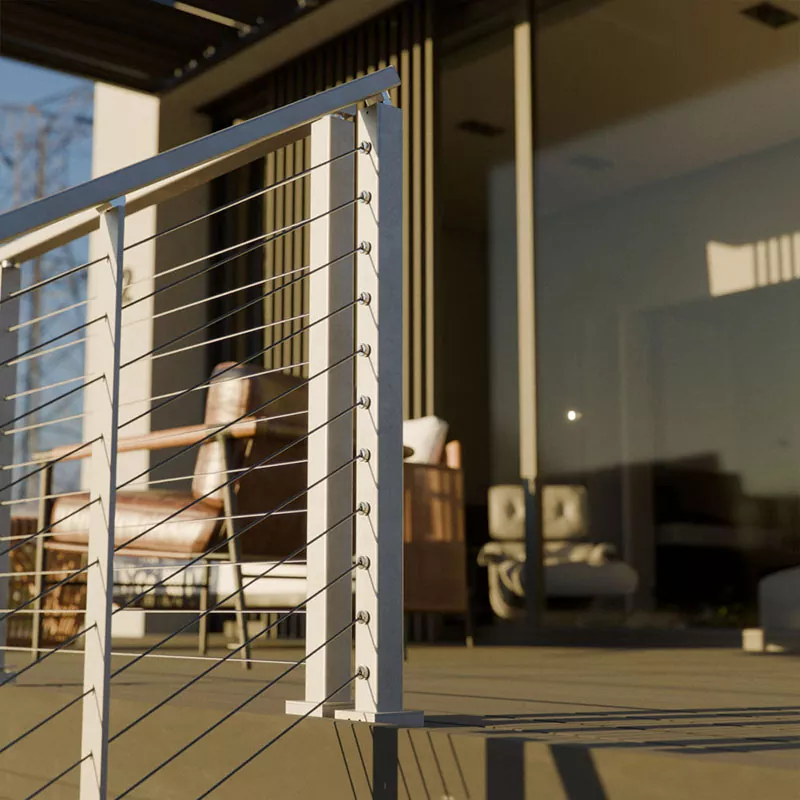
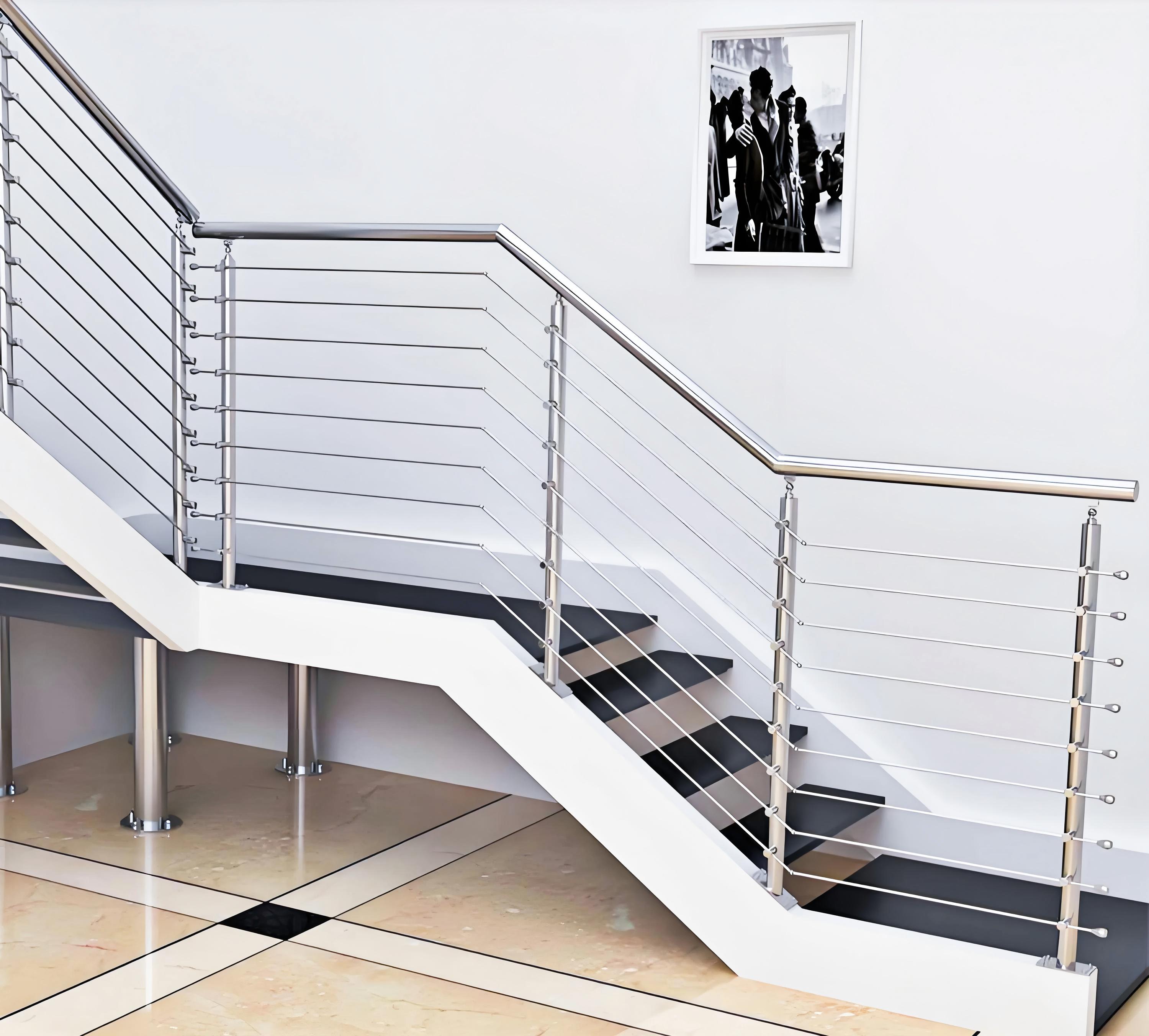
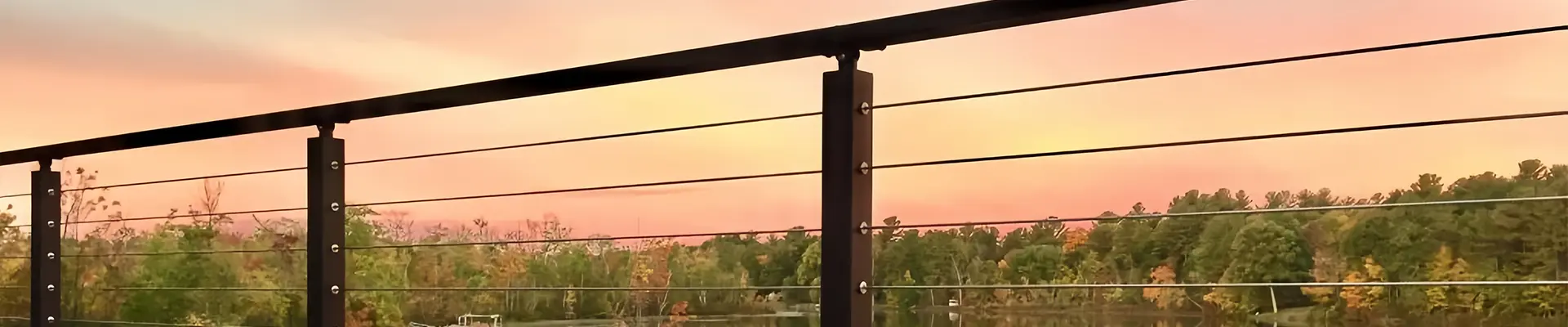
Cable railing systems meet the IRC 4-inch sphere rule differently than traditional baluster systems. The 4-inch sphere test applies to openings in the infill, and horizontal cable systems create openings between cable runs rather than between vertical balusters. The key code requirement for cable railing is that the cables must be tensioned tightly enough that a 4-inch sphere cannot pass through any opening in the assembly when the cables are subjected to the 50-pound concentrated load specified in the code. This means cable spacing and cable tension are both code-relevant variables. Horizontal cable systems are also scrutinized in some jurisdictions for their climbability; a child can use horizontal cables as a ladder, which is specifically mentioned as a concern in IRC R312.1.3. Some jurisdictions have interpreted this provision to prohibit horizontal cable infill entirely on residential decks, while others permit it with restrictions. Vertical cable systems do not raise the same climbability concern. Our team at Vionta Metal recommends confirming with your local building department before specifying a horizontal cable system, and we can provide documentation of our cable railing system's compliance testing to support permit applications.
Does stainless steel cable railing work with aluminum posts and top rails, or does the system need to be all one material?
Stainless steel cable absolutely works with aluminum posts and top rails, and this combination is actually one of the most popular configurations our customers at Vionta Metal specify. The aluminum post and rail system provides the structural framework, and the stainless cable runs between the posts as the infill. The two materials are compatible structurally and aesthetically, and the combination offers the best attributes of each: the formability, color options, and cost-effectiveness of aluminum for the frame, and the slender, view-preserving profile of stainless cable for the infill. One important detail to address in this combination is galvanic corrosion. Aluminum and stainless steel are relatively close on the galvanic series, but direct metal-to-metal contact in a wet environment can still cause cosmetic corrosion at the interface over time. Our cable railing hardware uses nylon-isolated thimbles and bushings at the point where the cable fitting contacts the aluminum post, which eliminates the galvanic contact point and prevents any corrosion between the two metals. This isolation detail is included as standard in our aluminum-post cable railing kits and requires no additional specification from the customer.
Does stainless steel cable railing add value to a home compared to traditional aluminum or wood railing?
Cable railing systems, particularly those with stainless infill and aluminum or wood posts, generally carry a positive valuation premium in real estate markets that value contemporary design and open views. Appraisers and real estate agents in view-oriented markets, waterfront neighborhoods, and contemporary design-focused communities typically note cable railing as a premium feature that supports higher valuations relative to traditional baluster systems. However, the premium is not universal. In traditional architectural neighborhoods, colonial or craftsman style home districts, and markets where buyers expect classic turned-wood baluster aesthetics, cable railing can actually reduce perceived appropriateness and in some cases perceived value. The most reliable way to evaluate the value impact for a specific property is to examine recent sales in the immediate neighborhood and see whether properties with cable railing have sold at premiums. From a pure physical durability and code-compliance standpoint, a well-installed aluminum deck railing system from Vionta Metal will serve the property as well as a cable system for resale purposes, particularly given the 20-year structural warranty and the low maintenance burden that appeals to buyers in any market segment.
Ready to Spec Your Deck Railing System?
Our team at Vionta Metal is here to help you select the right aluminum deck railing height, finish, and configuration for your specific project. Whether you are a homeowner planning a weekend build or a contractor managing a multi-unit development, our product specialists can turn your code requirements into a complete, ready-to-install system.
We respond to all inquiries within one business day. Sample orders typically ship within 5 business days.
Related News
- Are Jalousie Windows Easy to Break Into?
- Is Stainless Steel Glass Railing Safe?
- How waterproof is an aluminum louvered pergola during heavy rain, and how should its drainage capacity be tested?
- How Strong Is Aluminum Railing Compared With Steel Railing?
- How to Choose Metal Railing for Residential and Commercial Projects
- How To Remove Hard Water Stains From Glass Railings?
Leave me a message